


Getting married online is a fully legal way to tie the knot, but it requires a few key steps. Just like a traditional wedding, you’ll need to meet core requirements to make it official. The essentials are a valid government-issued photo ID, being at least 18 years old, and having one or two witnesses join your virtual ceremony.
Follow this guide to gather what you need and confidently move forward with your digital “I do.”
Your Essential Online Marriage Checklist: What You Need to Get Started
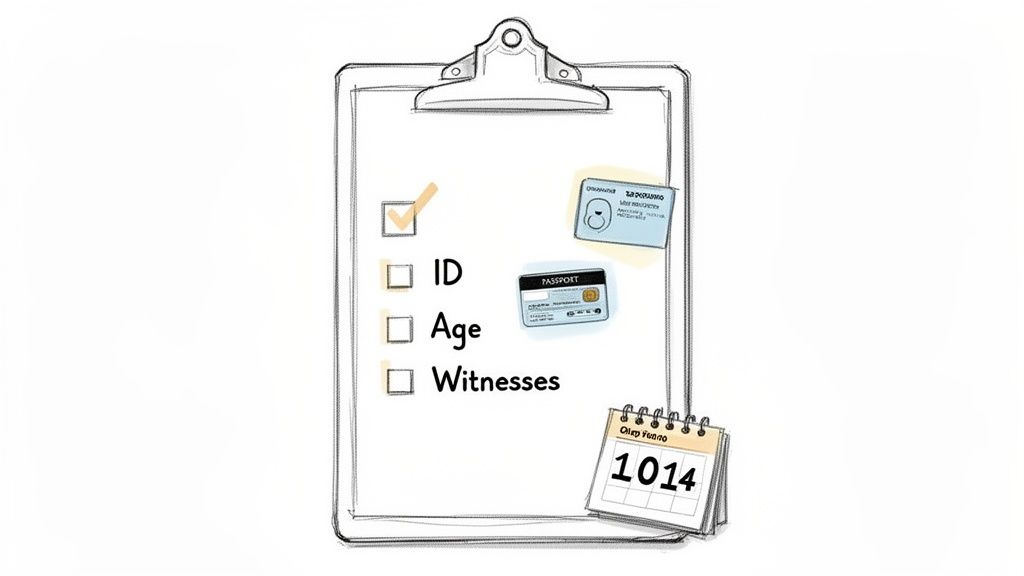
Before you can legally get married online, you’ll need to prepare a few documents. The process is designed to be simple, but having these items ready will ensure everything runs smoothly from start to finish.
Think of this as your pre-flight checklist. The goal is to prove your identity and eligibility to the state issuing your marriage license. Once you have these basics covered, you can proceed with the application with total confidence.
H3: Identity and Age Verification
First, you must prove you are who you say you are. This is a non-negotiable step to prevent fraud and legally confirm both partners’ identities.
To do this, you’ll need a valid, unexpired, government-issued photo ID. The most common and accepted forms of ID are:
- A state-issued driver’s license or ID card
- A passport (from any country)
- A military ID card
Action Step: Check the expiration date on your ID now. If it’s expired, get it renewed before you start your application.
For age verification, the rule is straightforward: in the United States, the standard minimum age to get married without parental consent is 18 years old. Both you and your partner must be at least 18 to apply for an online marriage.
H3: The Role of Witnesses
Just like a traditional wedding, witnesses are essential to make your virtual ceremony official. They act as legal observers who can confirm that they saw you and your partner willingly agree to get married.
Most online marriage services require at least one or two adult witnesses to be present on the video call.
Action Step: Choose your witnesses ahead of time. Ask one or two friends or family members who are reliable and have access to a device with a camera and internet. Let them know the date and time so they can be ready to join the video call.
Your witnesses must also be of legal age (usually 18 or older) and must be able to clearly see and identify both you and your partner during the ceremony. The good news? They don’t have to be in the same room—they just need a link to join the video call.
Core Requirements for a Legal Online Marriage
This table gives you a quick summary of the fundamental requirements for any legal online marriage ceremony.
| Requirement Category | What You Need | Actionable Tip |
|---|---|---|
| Proof of Identity | A valid, government-issued photo ID that is not expired. | Take a clear photo of your ID with your phone so it’s ready to upload. |
| Age Requirement | Both partners must be at least 18 years of age. | No action needed if you and your partner are over 18. |
| Witnesses | At least one or two adults to attend the virtual ceremony. | Confirm your witnesses’ availability and send them a calendar invite. |
As long as you have these three key things sorted out, you’re well on your way to a successful and legally sound online wedding.
How Are Online Marriages Actually Legal?
Many couples ask: is getting married online a loophole, or is it a truly legitimate marriage? The answer is simple: an online marriage is fully legal and built on long-standing U.S. law. Its validity isn’t a modern workaround; it’s anchored in the legal principle of state reciprocity.
The key is understanding where your marriage officially takes place. Your marriage isn’t legally tied to your physical location—whether that’s your living room in California or a hotel in Tokyo. Instead, its validity is anchored to the state that issues your marriage license.
The Power of the Issuing State
Think of it like getting a driver’s license. If you get your license in Texas, you can legally drive in all 50 states. You don’t have to get a new license every time you cross a state line because every other state recognizes the validity of the one Texas issued.
An online marriage works on the exact same principle. When a state like Utah issues a marriage license for a virtual ceremony, that license is just as valid as one you’d get by walking into a county clerk’s office. The ceremony is legally conducted under that state’s jurisdiction, no matter where you and your partner are in the world.
This concept is the bedrock of why online marriages are not just possible but fully recognized across the country and, in many cases, internationally. The “magic” isn’t in the technology; it’s in well-established legal precedent.
Understanding Universal Reciprocity
The legal mechanism that makes this all work is known as universal reciprocity, a principle that flows from the Full Faith and Credit Clause of the U.S. Constitution. In plain English, this clause requires every state to recognize and honor the public acts, records, and judicial proceedings of every other state.
A marriage that is legally performed and registered in one state is legally valid in all other states. This isn’t a special exception for online weddings; it’s a rule that has upheld the validity of all marriages for centuries.
So, once your online marriage is finalized and your certificate is issued by a state like Utah, your marriage is legally recognized everywhere from New York to Hawaii. You don’t need to do anything extra to “register” it in your home state. It’s already official.
This is the legal framework that makes getting married online a practical and secure option for couples everywhere. It provides the exact same legal rights, benefits, and responsibilities as a traditional, in-person wedding.
Why Certain Counties Are Online Marriage Hubs
While several states have provisions for remote ceremonies, you’ll find that certain counties have become true hubs for online marriages. Utah County, Utah, is a perfect example. They didn’t just allow it; they actively created a simple and efficient process for couples all over the world.
Their system is designed from the ground up for accessibility, letting couples:
- Apply for a marriage license entirely online.
- Complete identity verification through a quick video call with a county clerk.
- Hold their ceremony from any location with an internet connection.
This forward-thinking approach has completely removed traditional barriers like residency requirements or waiting periods. That’s what makes them a go-to for international, military, and long-distance couples. By building a clear and legally sound digital infrastructure, they’ve proven that a virtual wedding is every bit as legitimate as a traditional one.
This focus on digital access just reflects a bigger trend in how we plan weddings now. A recent study from The Knot shows that 90% of couples handle every detail of their wedding planning online, from finding vendors to managing guest lists. With nearly half of all couples using QR codes for RSVPs, the move toward digital solutions is undeniable. You can dive deeper into how couples are using tech for their big day by exploring The Knot’s 2024 Real Weddings Study. The ceremony itself is just the next logical step in this digital shift, making marriage more accessible than ever before.
Your Step-by-Step Guide to Getting Married Online
You understand the legal side. Now, let’s walk through the exact steps to get you from “ready” to “married.” This is your practical game plan for navigating the online marriage process, broken down into simple, actionable tasks.
The process is designed to be straightforward. This graphic shows you the flow: get your license, have it validated by state law, and see it recognized everywhere else.
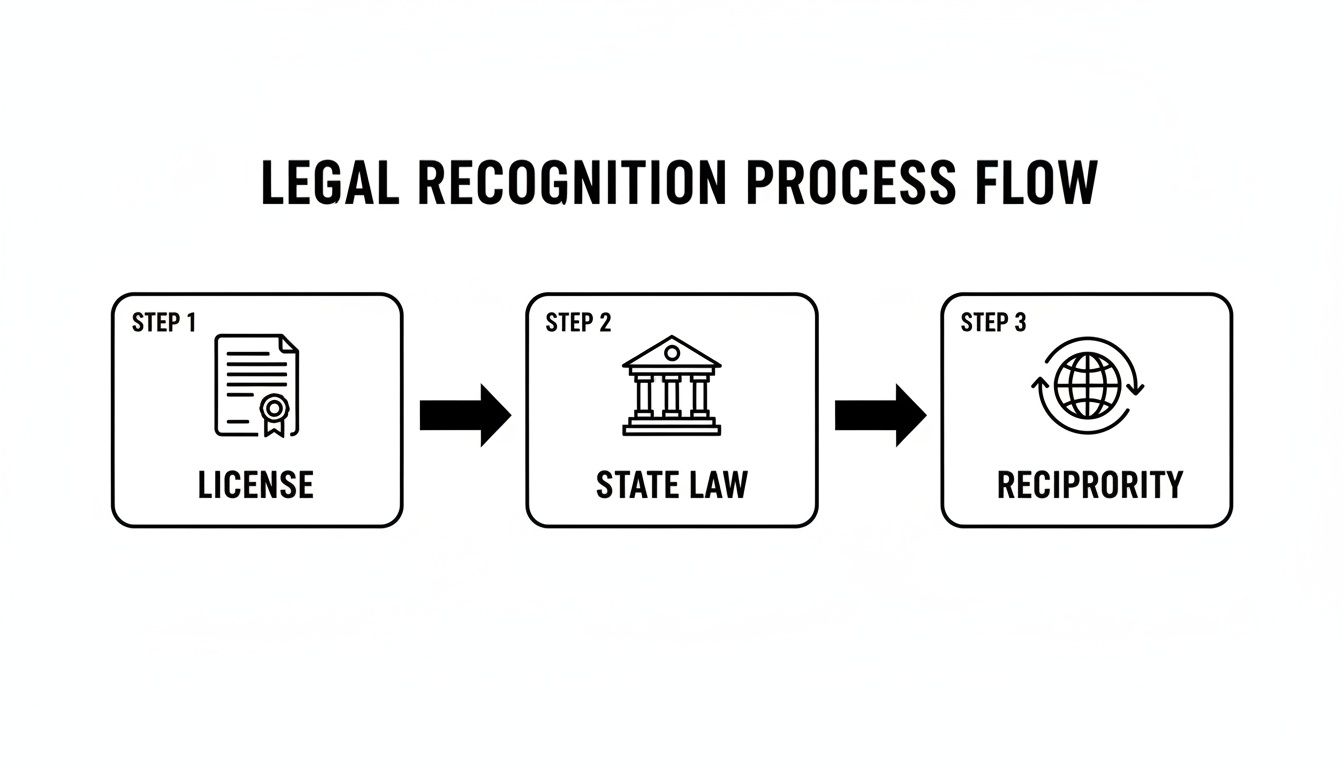
It all flows from a valid license issued under a specific state’s laws, which then becomes legally binding everywhere else.
Step 1: Gather Your Essential Documents
Before starting your application, have your IDs ready. Both you and your partner need a valid, unexpired, government-issued photo ID. This is how the county clerk’s office officially confirms your identities.
Action Step: Locate your ID. The most common forms work perfectly:
- A state-issued driver’s license or ID card from any U.S. state.
- A valid passport from any country in the world.
- A U.S. military ID card.
Make sure they aren’t expired and the photos are current. Getting this right from the start prevents any delays.
Step 2: Complete Your Online Application
With your documents in hand, fill out the marriage license application. Services like Marryfromhome.com simplify this by turning a government form into an easy online questionnaire.
Action Step: Sit down with your partner (virtually or in person) and fill out the form together to ensure all details—full legal names, birthdays, addresses—are accurate.
Step 3: Verify Your Identity on a Video Call
After submitting your application, you’ll have a brief identity verification call with an official from the county clerk’s office.
Action Step: During the call, hold your photo ID up to the camera when asked. The clerk will match your face to the ID and confirm the information you submitted.
This video call serves the exact same purpose as standing before a clerk in person. It’s the official confirmation that you are both real people consenting to the marriage.
This step is fast—usually just a few minutes—but it’s what gives your application the final green light.
Step 4: The Ceremony With Your Officiant and Witnesses
Once your license is approved, it’s time for the ceremony. Your wedding will take place over a video call (like Zoom) with a legally licensed officiant.
Action Step: On your wedding day, find a quiet, well-lit space. Send the video call link to your witnesses and log in a few minutes early to test your audio and video. The officiant will guide you through the vows and make the moment feel both personal and official.
Step 5: Receive Your Official Marriage Certificate
After you’ve said your “I dos,” the officiant signs the marriage license and submits it to the county clerk’s office to be recorded.
Action Step: Watch your email for the digital copy of your marriage certificate, which usually arrives quickly. Once the certified hard copy arrives in the mail, store it in a safe place. This certificate is your legal proof of marriage, valid across the U.S. and, with an Apostille, around the globe.
Why State Laws and International Recognition Matter
Choosing the right state for your online marriage is the most strategic decision you’ll make. This choice directly impacts the simplicity of the process and how easily your marriage is recognized, both in the U.S. and internationally.
Not all states have the same rules. Some, like Utah, have fully embraced a remote process, eliminating residency or in-person requirements. This is what allows services like Marryfromhome to help couples from anywhere in the world get married.
The Utah Advantage: Fully Remote and Accessible
States offering a completely remote marriage process are the gold standard for online weddings because they are built for accessibility.
Actionable Insight: By choosing a service that operates out of a fully remote state like Utah, you can:
- Apply for your marriage license from your home country or state.
- Complete identity verification via a quick video call.
- Hold your ceremony with an officiant and witnesses who are also remote.
This approach removes major barriers, such as residency rules or travel requirements. This legal flexibility is what makes online marriage a practical option for long-distance, military, and international partners. You can dive deeper into the specifics in our guide on which U.S. states allow online marriage.
It’s a legal evolution that perfectly mirrors how modern relationships begin. With estimates suggesting that 61% of couples met digitally, it’s clear that online connections are now the norm for romance. For more on this, check out the insights at South Denver Therapy’s blog on the topic. The ability to get married online is simply the next logical step.
Comparing State Approaches to Online Marriage
To see how much state laws differ, here’s a comparison between fully remote states and those with more restrictions.
| Feature | Fully Remote States (e.g., Utah) | States with Restrictions |
|---|---|---|
| Residency Requirement | No residency required. You can live anywhere in the world. | Often requires one or both partners to be a state resident. |
| Physical Presence | None. The entire process is done via video conference. | May require picking up the license in person or one partner being physically present in the state. |
| Global Recognition | Straightforward, especially with an Apostille. | Can be more complex, as the process may not be designed for international couples. |
| Speed & Convenience | Fast and efficient. Often completed in just a few days. | Slower, involving travel and appointments with county clerk offices. |
The difference is clear. For a truly accessible and global option, choosing a service based in a fully remote state like Utah is the most practical path.
Navigating International Recognition and the Apostille
For international couples, getting your U.S. marriage recognized in another country is the final goal. To do this, you’ll need a special document called an Apostille.
An Apostille is an official certificate that authenticates your marriage certificate, confirming its legitimacy for foreign governments. It’s issued by the same state that granted your marriage license.
Action Step: If you or your partner live outside the U.S. or plan to, request an Apostille immediately after receiving your marriage certificate. This will ensure your marriage is accepted as valid for visa applications, residency, and other legal matters abroad.
The process is straightforward. This small but vital step bridges the gap between different legal systems, turning a U.S. document into a globally recognized one.
The People and Tech That Bring Your Online Wedding to Life
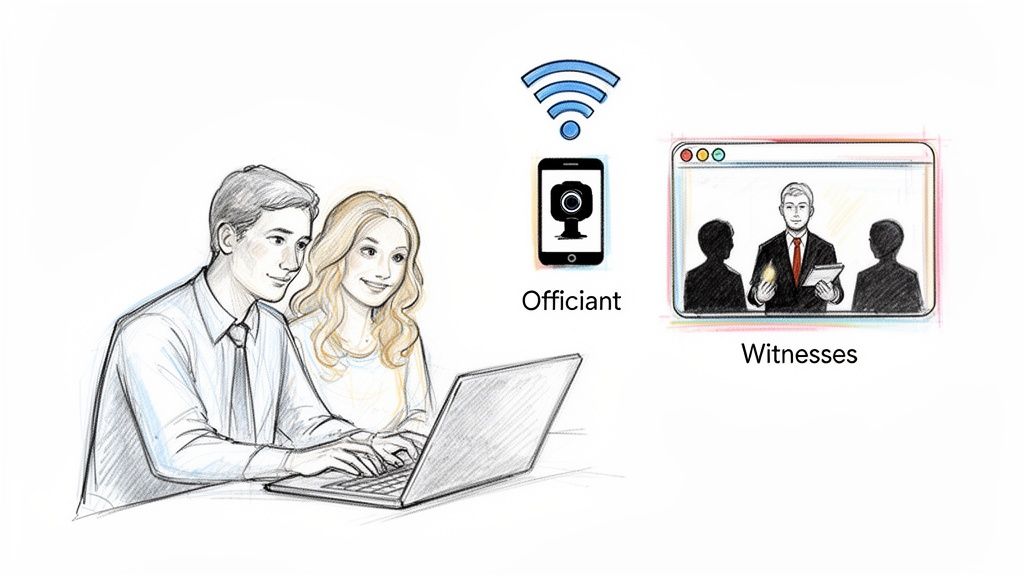
An online wedding combines simple technology with genuine human connection. You don’t need special equipment or tech skills; if you can make a video call, you have everything you need. The entire ceremony depends on just a few basic tools, making it a practical choice for anyone.
Your Simple Tech Toolkit
Your technology needs are minimal. The only goal is a clear, stable connection so everyone can see and hear the ceremony.
Here’s your tech checklist:
- A Device with a Camera: Any modern smartphone, tablet, or laptop will work.
- A Stable Internet Connection: A reliable Wi-Fi or cellular data connection is key.
- A Video Conferencing Platform: Most ceremonies use familiar, free platforms like Zoom.
Action Step: A day before your ceremony, do a test call with your device from the location you plan to use. This ensures your internet connection is strong and your camera and microphone are working perfectly.
This shift to digital life events just makes sense. After all, so many modern love stories already start online. According to The Knot’s Real Weddings Study, a whopping 27% of recently married couples first met on a dating site or app. Getting married online is simply the next natural step. You can read more about this in The Knot’s latest findings on modern relationships.
The Human Element of Your Virtual Ceremony
While technology sets the stage, it’s the people who make your wedding official and meaningful. Two roles are essential: the officiant and the witnesses.
The licensed officiant is the legally authorized person who conducts your ceremony, guides you through your vows, and handles the filing of your marriage license.
Your officiant is the legal and ceremonial anchor of your wedding. They ensure every requirement is met while helping create a personal and memorable moment for you and your partner.
Your witnesses are the official observers who must be on the video call to see you both consent to the marriage. Their presence legally validates the union.
Platforms like Marryfromhome.com act as your digital wedding coordinator, providing the licensed officiant, managing the technology, and guiding you and your witnesses through every step. This ensures your online marriage is not only legally sound but also a joyful and stress-free experience. To learn more about different remote wedding formats, check out our article explaining the differences between virtual, proxy, and web-conference weddings.
Your Top Questions About Online Marriage, Answered
As you plan your online wedding, questions are bound to come up. This section provides direct answers to the most common queries we hear, giving you the clarity and confidence to move forward.
Is an Online Marriage as Legal as a Traditional One?
Yes, absolutely. A marriage performed online is 100% legally equivalent to an in-person wedding. Its legality is determined by the state issuing the marriage license, not the venue. Thanks to the Full Faith and Credit Clause of the U.S. Constitution, a marriage that’s valid in one state is recognized across all other states. Your marriage carries the exact same legal weight as any other.
Can International Citizens Get Married Online Through the US?
Yes. You do not need to be a U.S. citizen or resident to get legally married online through a state like Utah. This is a game-changer for international and binational couples, as it removes geographic and residency barriers.
Actionable Tip: If you need your marriage recognized in another country, you must get an Apostille. This document authenticates your U.S. marriage certificate for foreign governments, making it officially accepted for visas and residency. For more details, our article on how online marriage can impact spouse visa applications has helpful information.
What Happens After the Ceremony to Make It Official?
The process is designed to be seamless and automatic. Here’s what happens behind the scenes:
- Officiant Signs and Files: Immediately after your ceremony, your officiant digitally signs and submits the marriage license to the county clerk’s office.
- County Clerk Records It: The clerk’s office processes the license, officially entering your marriage into public records. At this moment, your union becomes legally binding.
- Certificate Issued: The county issues your official marriage certificate. You’ll get a digital copy quickly, often within a business day.
- Hard Copy in the Mail: A certified hard copy of your marriage certificate is then mailed to you. This is the official document you’ll use for everything moving forward.
Do We Need to Be Physically in the Same Room?
No. You and your partner do not have to be in the same physical location. This is a major benefit for long-distance and international couples. As long as both of you, your officiant, and your witnesses are all present on the same video conference call, you meet the legal requirement of being “present” for the ceremony.
The legal principle of “appearance by video” confirms that as long as everyone can see, hear, and interact in real-time, the requirement for all parties to be “present” is fully met.
This flexibility allows you to legally commit to each other without waiting until you can be in the same place at the same time.
Ready to take the next step and make your marriage official? At Marryfromhome.com, we handle all the details so you can focus on your special moment. We make getting legally married online from anywhere simple, secure, and stress-free.


