


Deciding what to do with your last name after you get married online is a big deal, and it’s deeply personal. One option that’s getting more and more popular for modern couples is choosing to hyphenate last names after marriage.
This route lets both partners keep a piece of their own history while building a new, shared family identity. It’s a pretty powerful way to show you’re an equal partnership from day one, especially when you’re starting your marriage in a modern, digital way.
Why Modern Couples Choose a Hyphenated Name
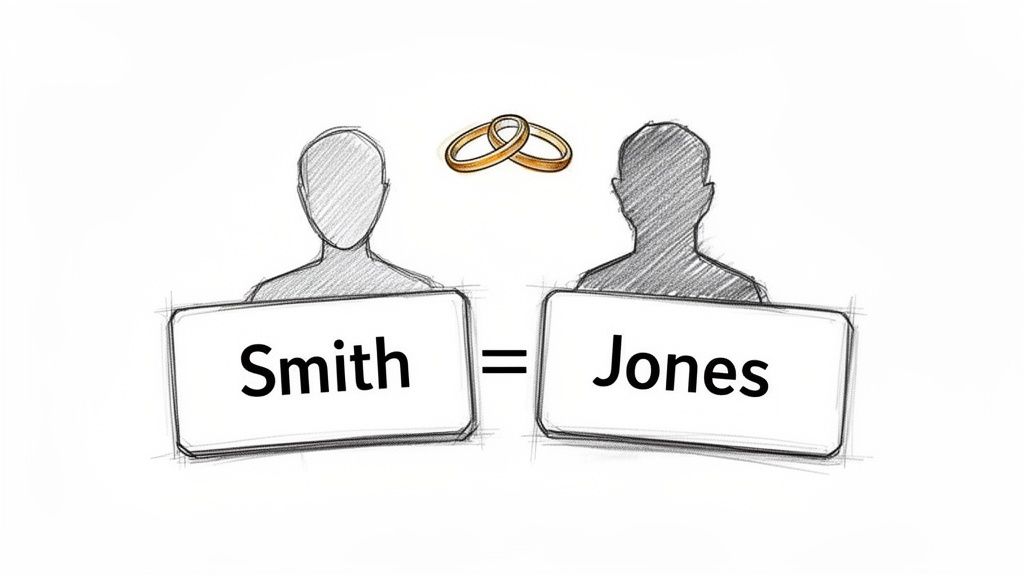
For a lot of couples, especially those getting married online, the decision to hyphenate goes way beyond just a name. It’s a statement about how they see their partnership, their identity, and their family values. This choice steps away from old traditions, giving you a way to weave two family stories into one future.
Honoring Professional and Personal Identity
Many of us build a professional reputation long before we even think about marriage. If you’re a doctor, lawyer, artist, or entrepreneur, you might have years of work, published articles, and a whole network of contacts tied to your birth name.
Hyphenating lets you embrace your new family name without giving up the professional identity you’ve worked so hard to build. It creates a clear bridge between your past achievements and your future, so clients and colleagues don’t get confused.
Preserving Family Heritage
Your last name is your most direct link to your family’s history. For some, the idea of letting that go feels like losing a part of themselves or cutting ties with their roots. Hyphenation is a fantastic solution here.
By combining both names, you create a new legacy that respects and includes both families. It’s a way of saying, “We are starting something new together, but we haven’t forgotten where we came from.”
This can be especially meaningful if you or your partner are the last in your family line to carry that surname.
A Symbol of Modern Partnership
The move toward hyphenation is part of a much bigger cultural shift. A detailed 2023 Pew Research Center survey found that 5% of women in opposite-sex marriages chose to hyphenate, and that number is even higher among younger generations. This shows a real desire for naming choices that reflect equality within a marriage. You can dig into more of these stats in the full Pew Research findings.
This is just one of the many ways couples are making their weddings their own. If you’re looking for other unique ways to celebrate, you might like our guide on non-traditional and alternative wedding ideas.
The First Legal Step: Your Marriage License
Your journey to a hyphenated last name starts the moment you fill out your marriage license application. For couples getting married online, this step is often handled digitally, making it crucial to get every detail right before you click “submit.” This one document is the key to a smooth, headache-free process down the road.
Think of the application as more than just a form; it’s where you legally declare your new name. If you get this foundation right, everything that follows—updating your ID, bank accounts, and professional identity—will be solid.
Deciding the Name Order and Sticking to It
Before starting your online marriage application, you and your partner need to make a firm decision: whose name goes first? To the legal system, “Smith-Jones” and “Jones-Smith” are two completely different names. There’s no right or wrong answer here; it’s a personal choice. Say both versions out loud, see what feels natural, and then lock it in.
Once you’ve decided, that exact format must be entered on the marriage license application in the space for your “new name after marriage.” Consistency is everything from this point forward. Every single document you update must match the name on your certified marriage certificate exactly.
This is a common stumbling block. A tiny inconsistency can cause rejected applications, frozen bank accounts, and stressful travel delays. If you need a quick review of the documents you’ll need for the license itself, our guide on what you need for a marriage license can help you get organized.
What if the Certificate Is Already Issued?
So, what happens if you’re holding your marriage certificate from your online ceremony right now and it doesn’t show your new hyphenated name? Unfortunately, this is where things get a lot more complicated and expensive.
Key Takeaway: If your hyphenated name isn’t on your marriage certificate, the certificate alone isn’t enough proof for a name change. You can’t just start using the name and expect it to be legally recognized.
You’ll have to go through a formal, court-ordered name change. This process usually involves:
- Filing a petition with your local court system.
- Paying hefty filing fees, which can often run several hundred dollars.
- Potentially appearing at a court hearing for a judge’s approval.
- Publishing the name change in a local newspaper, depending on your state’s rules.
This path takes way more time, money, and hassle than getting it right on the marriage license from the start. It really drives home why being careful with that initial application is so important.
This is especially true for women building their careers, where administrative consistency is vital. Interestingly, research from The Female Quotient shows that women in the Western U.S. are 9% more likely to hyphenate, a trend often tied to maintaining a professional identity. You can dig deeper into the maiden name debate and its implications in their full report.
Updating Your Identity with Government Agencies
With your certified marriage certificate from your online wedding in hand, it’s time to make your new, hyphenated name official. The process is all about following the proper sequence, and it absolutely has to start with the Social Security Administration (SSA). Think of them as the gatekeeper. Once your name is updated in their system, everything else falls into place.
This flowchart lays out the big picture, showing how the groundwork you lay before this point is critical.
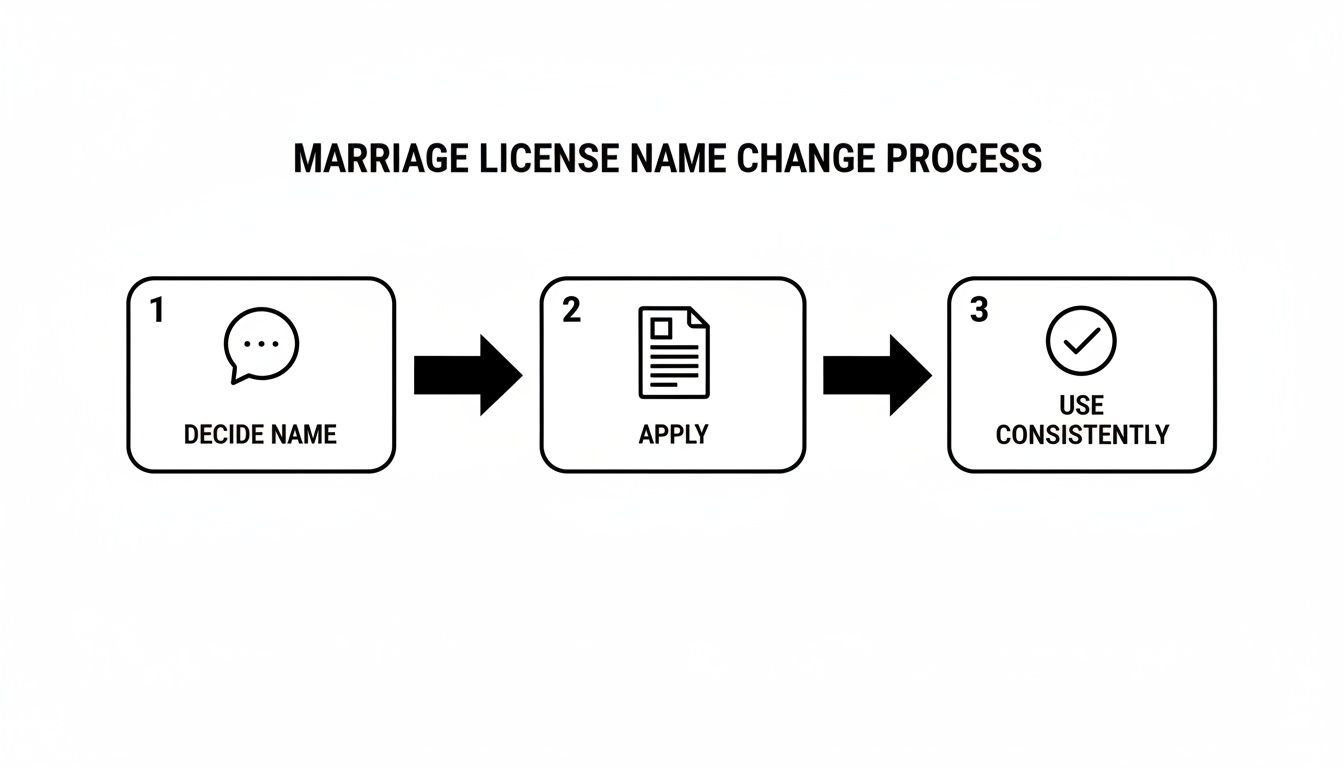
As you can see, the process begins way before you set foot in a government office—it starts with your decision and making sure that new name is on your marriage license.
Tackling the Social Security Administration First
Hitting up the SSA first isn’t just a suggestion; it’s a non-negotiable first step. Pretty much every other agency, from the DMV to the Passport Agency, cross-references your information with the SSA database. If you try to update your driver’s license before your Social Security card, you’re almost guaranteed to get rejected. Don’t waste the trip.
To kick things off, you’ll need to fill out Form SS-5, the Application for a Social Security Card, which you can grab from the SSA website. Along with the form, you’ll have to prove who you are, how old you are, and that your name has legally changed.
Here’s a quick checklist of what to have ready:
- Proof of Name Change: Your original marriage certificate or a certified copy. This is the star of the show.
- Proof of Identity: A current, unexpired U.S. driver’s license, passport, or state-issued ID card.
- Proof of U.S. Citizenship: Your U.S. birth certificate or passport does the trick.
Once your application is submitted, your new card should arrive in the mail within 7-14 business days. The best part? The whole process is completely free.
A pro tip for couples married online is to request multiple certified copies of your marriage certificate right away. Having at least three copies on hand can be a real lifesaver, preventing delays when you need to mail one in or show up to different appointments.
Your Next Stops: The DMV and Passport Agency
Once that new Social Security card lands in your mailbox, you’re clear to update your other key IDs. I’d give it a few business days for the SSA’s system to fully refresh before you head to the DMV, just to be safe.
For your driver’s license or state ID, you’ll have to make an in-person visit. The paperwork is similar to the SSA’s, but you should always double-check your state’s DMV website for their exact list. Generally, you’ll need:
- Your new Social Security card
- Your certified marriage certificate
- Your current driver’s license
- Proof of residency, like a recent utility bill or bank statement
Updating your passport is equally important, especially if you have any international travel on the horizon. If your passport was issued less than a year ago, you can use Form DS-5504 for a free update. For older passports, you’ll need to file for a renewal using Form DS-82, making sure to include your marriage certificate and a new photo. And remember, the name on your travel tickets must always match the name on your passport. No exceptions.
Since your wedding was virtual, it’s helpful to know how that digital ceremony translates into the physical documents you’ll need for these steps. You can learn more about how to get a legal marriage certificate online to make sure you start with the right paperwork from day one.
A Checklist for Your Financial and Professional Overhaul
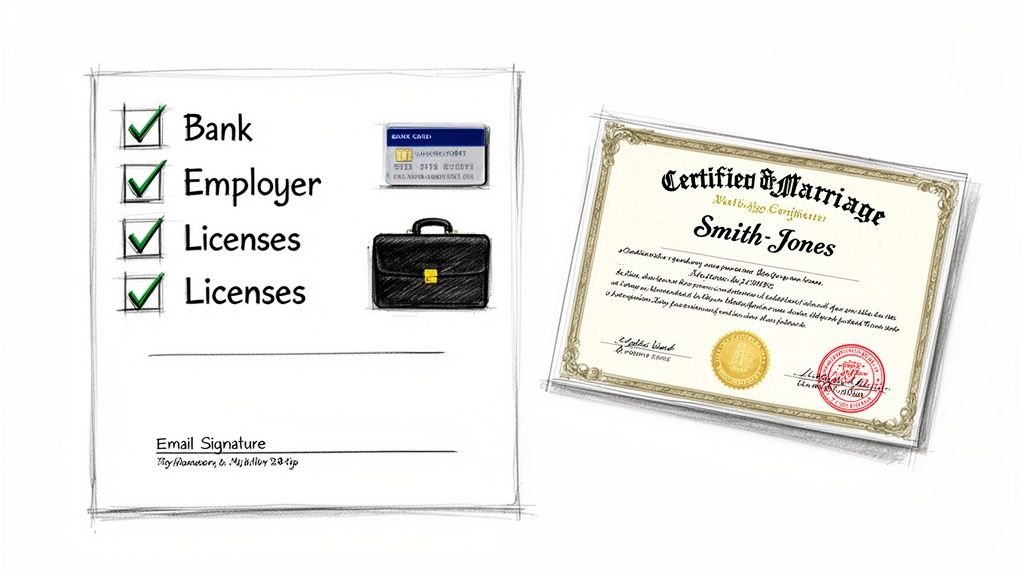
Alright, you’ve conquered the Social Security office and the DMV. You’re holding the two golden tickets—your new Social Security card and driver’s license—that unlock the rest of your name-change journey.
Now comes the part that can feel like death by a thousand papercuts: updating everything else. The secret is to be methodical. Think of it as a domino effect—tackle the big things first, and the smaller ones will fall into place much more easily.
Start with the most critical areas: your money and your job. These are the places where a name mismatch can cause real headaches, from a paycheck not depositing to a credit card getting declined.
Securing Your Financial Identity
Your first stop after leaving the DMV should be your bank. For security reasons, most banks and credit unions will require you to show up in person to update your name. It’s a good idea to call ahead and ask exactly what documents they need, but you can bet on needing your new driver’s license and a certified copy of your marriage certificate.
Once your main bank account is sorted, you can start working your way through the rest of your financial life. Don’t get overwhelmed; just tick them off one by one.
- Credit Cards: Flip over each card and call the customer service number on the back. They’ll walk you through their specific process, which usually just means sending them a quick picture or copy of your new ID.
- Retirement Accounts: Get in touch with your 401(k) or IRA provider. This is a big one. You need to ensure your beneficiary information is correct and that you won’t have any trouble accessing your funds down the road.
- Loans and Mortgages: Don’t forget to notify your auto loan, student loan, and mortgage lenders. A name mismatch here can lead to issues with payment processing or screw up your tax documents.
- Investment Accounts: If you have a brokerage account or use any investment platforms, update your name there to keep your tax reporting accurate.
My Two Cents: While you’re at the bank, ask for new debit cards on the spot. It’s also a good time to order a fresh set of checks with your new hyphenated name so you’re not caught without them.
Aligning Your Professional World
Next up, let’s get your work life in order. Your name is a key part of your professional brand, so consistency is everything. Your first port of call should be your company’s Human Resources department.
HR is your command center for this. They’ll update your name in all the internal systems, which should automatically cascade down to things like payroll, health insurance, and other employee benefits. They’ll almost certainly ask for copies of your new Social Security card and driver’s license, so have them ready.
After HR has done its thing, it’s time to refresh your public professional identity.
- Professional Licenses: This is a must-do if you’re a doctor, lawyer, nurse, real estate agent, or hold any other state-issued professional license. Contact your licensing board to get your name updated. It’s often a legal requirement to practice under your current name.
- Email Signature: This is the easiest win of the day. Update your email signature to reflect your new hyphenated name right away.
- Online Profiles: Time for a digital audit. Go through your LinkedIn profile, the company directory, and any professional networking sites you use. Make sure your new name is consistent everywhere to avoid confusing clients, colleagues, and recruiters.
To help you keep track of everything, I’ve put together a simple, prioritized checklist. Work your way down the list, and you’ll have everything updated in no time.
Your Hyphenated Name Update Checklist
| Category | Entity to Update | Key Document Required |
|---|---|---|
| Government & ID | Social Security Administration | Marriage Certificate, Old ID |
| Government & ID | DMV / Driver’s License | New SSN Card, Marriage Certificate |
| Government & ID | U.S. Passport Agency | New ID, Marriage Certificate, Photos |
| Government & ID | Voter Registration | New ID |
| Financial | Banks & Credit Unions | New ID, Marriage Certificate |
| Financial | Credit Card Companies | New ID |
| Financial | Retirement Account Providers (401k/IRA) | New ID, Marriage Certificate |
| Financial | Loan & Mortgage Lenders | New ID, Marriage Certificate |
| Professional | Employer / Human Resources | New SSN Card, New ID |
| Professional | Professional Licensing Boards | New ID, Marriage Certificate |
| Personal & Digital | Landlord or Property Manager | New ID, Marriage Certificate |
| Personal & Digital | Doctors & Insurance Providers | New ID |
| Personal & Digital | Email & Social Media Accounts | New ID (sometimes) |
| Personal & Digital | Utilities (Gas, Electric, etc.) | New ID |
Tackling this list systematically will save you a world of confusion later. Just remember to keep your certified marriage certificate and new ID handy—they’re your keys to getting everything done.
Thinking About the Long-Term Impact of a Hyphenated Name
Deciding on your name is a huge milestone, but it’s also a choice that will follow you through your personal and professional life for years. Before you commit to the hyphen, it’s worth having a real, honest conversation with your partner about what this decision looks like five, ten, or even twenty years down the road.
This isn’t about finding a “right” or “wrong” answer. It’s about making a fully informed choice that feels right for your shared vision of the future and prevents potential headaches later.
Professional Branding and Social Perceptions
Your name is a core part of your professional identity. Think about how a longer, hyphenated name will fit on business cards, professional licenses, or your LinkedIn profile. For some people, it’s a powerful way to bridge their established career with their new married life. For others, a long or complex name can feel clunky in certain industries.
It’s also smart to acknowledge how others might see your choice. A 2021 study pointed out that women who took their husband’s surname had marriages that were about 60% longer than those who kept or hyphenated theirs. Now, this is a correlation, not a guarantee of cause and effect, but it does show the symbolic weight some people attach to last names. Discover more insights from this study about marriage and naming choices. Thinking about this can help you feel confident that your decision is authentic to your own values, not just a reaction to societal expectations.
Planning for Future Children
The conversation about children’s last names is one of the biggest long-term things to consider. Will they also carry the hyphenated name? If they do, what happens if they one day marry someone else with a hyphenated name?
Many couples who hyphenate their own names choose one of the two original surnames for their children to keep things simpler for the next generation. Discussing these scenarios now prevents difficult decisions under pressure later.
Here are a few common ways couples handle it:
- Give kids the full hyphenated name (e.g., Smith-Jones).
- Choose one parent’s original last name for all children.
- Use one surname as a middle name and the other as the last name.
- Alternate names between children, though this is much less common.
Navigating Family Expectations
Finally, get ready for conversations with family members who might hold more traditional views. Relatives often have assumptions about what you “should” do, and their questions can be stressful if you aren’t prepared for them.
Having a united front with your partner is everything. You can explain your reasoning calmly, framing it as a choice that honors both families and reflects your modern partnership. By talking through these long-term impacts together, you solidify your decision as a team, confident that it’s the perfect fit for the life you’re building.
Common Questions About Hyphenating Your Last Name
Deciding to hyphenate your last name is a big step, and it’s natural to have a few questions pop up along the way. Even with the best plan, some details can feel a bit fuzzy. Let’s clear up some of the most common queries we hear from couples, especially those who just tied the knot online.
Can Both Partners Hyphenate Their Last Names?
You bet. It’s actually a growing trend for both partners to adopt the same hyphenated surname, which is a fantastic way to create a brand-new family name that belongs to both of you equally. Think of it as a powerful symbol of your partnership.
The process is exactly the same for both of you. You’ll each list the new, shared hyphenated name on your marriage license application. From there, you’ll follow the same name-change checklist to update your IDs and accounts with the Social Security Administration, DMV, and everywhere else.
Does the Order of the Names Matter?
Yes, it matters a great deal. From a legal standpoint, “Smith-Jones” is a completely different name than “Jones-Smith.” They are not interchangeable, so you and your partner need to decide on one official order before you ever touch that marriage license application.
Once that name is on the license, that’s it. You have to use it with 100% consistency on every single document from that day forward. Any mix-ups can lead to rejected applications and serious headaches, especially when dealing with banks or airport security.
Is Using a Space Instead of a Hyphen a Good Idea?
While you can legally use two last names with a space, we strongly advise against it. Many official databases and old-school computer systems just aren’t built to handle a two-word last name. This can cause all sorts of problems, like one of your names getting dropped from records or your files being indexed incorrectly.
A hyphen acts like legal glue, binding the two names into a single unit that computer systems can easily recognize. It’s a much cleaner approach that dramatically cuts down on the risk of errors on your tax returns, official forms, and travel documents. For your own sanity, the hyphen is the safest bet.
What Happens If I Regret Hyphenating My Name?
Walking back a legal name change isn’t as simple as just switching back. If you decide later on that you want to revert to your old name, you’ll have to go through a formal, court-ordered name change. This process is far more complicated and expensive than the change you make with your marriage license.
Typically, it involves filing a legal petition with the court, paying hefty fees, and potentially even appearing before a judge. Because of this, it’s really important to feel confident and settled in your decision before you start the official process of hyphenating.
Ready to start your journey together the simple way? At Marryfromhome.com, you can get legally married online from anywhere. Learn more about how it works.


