


Yes, you can absolutely get married online, and the resulting marriage is 100% legally binding. This isn’t just a symbolic ceremony—it’s a real, government-recognized marriage that ends with an official certificate in your hands. This guide will walk you through exactly how to do it, step by step, using forward-thinking U.S. states that allow couples to complete the entire process remotely, no matter where they are in the world.
Yes, You Can Legally Get Married Online
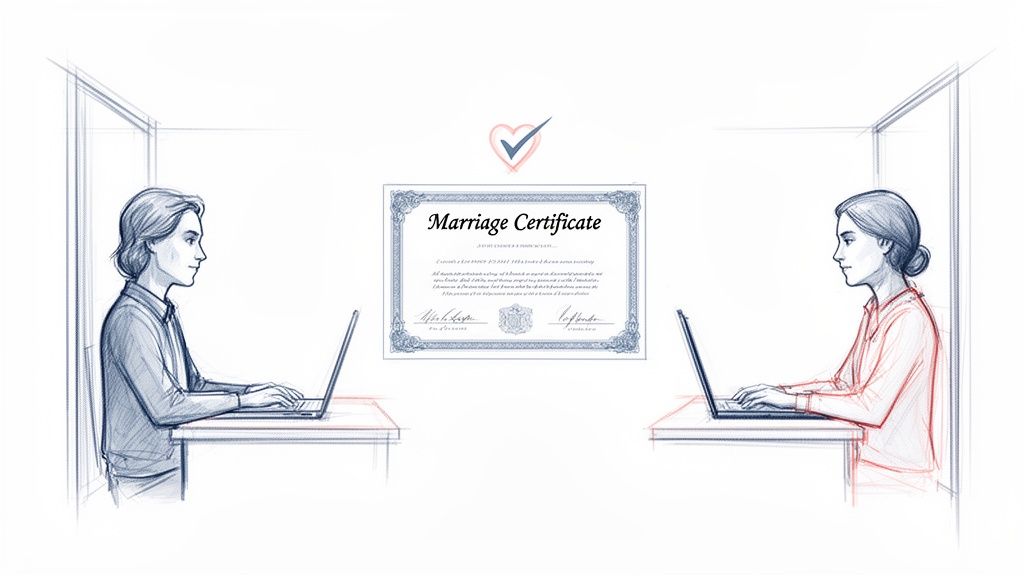
If you’re wondering whether an online wedding holds the same legal weight as a traditional one, the answer is a firm “yes.” The key is understanding how it all works. An online marriage isn’t a new category of matrimony; it’s a real, official marriage that uses technology to bring everyone together legally and conveniently.
Think of it like getting a remote job. Instead of driving to an office, you use video calls to conduct official business. Online marriage applies that same logic to your wedding, using legally approved video conferencing to connect you, your partner, and a licensed officiant in a recognized U.S. jurisdiction.
The Legal Foundation
The entire system works because specific U.S. counties, like Utah County, have updated their laws for the digital age. They pioneered a secure system for online marriage licensing and ceremonies, allowing officiants and couples to participate remotely via video. This makes the marriage legally binding not just in Utah, but across all 50 states and in most countries worldwide. You can discover more insights about this legal evolution and what it means for modern couples.
This legal framework is a game-changer. It means that even if you live in a state or country that doesn’t offer online marriage directly, you can still get legally married through a U.S. state that does. Your marriage certificate is issued by that state, and from there, it’s recognized virtually everywhere else.
Actionable Takeaway: Your marriage is legally recorded in the U.S. state where the officiant is located, granting it the same legal status as if you had traveled there in person. This is what makes it official.
What A Legal Online Marriage Means For You
Understanding the benefits can bring instant peace of mind and help you decide if this is the right path for you. To make it simple, here is a quick summary of what you get when you get legally married online.
Online Marriage At A Glance
| Aspect | Key Takeaway |
|---|---|
| Legal Validity | Your marriage is 100% legally binding with an official, government-issued certificate. |
| Location Independence | You and your partner can get married from anywhere in the world, without travel. |
| U.S. Recognition | The marriage is recognized across all 50 U.S. states due to constitutional clauses. |
| Global Recognition | It is recognized in most countries worldwide, often with an Apostille for validation. |
In short, an online marriage gives you a legitimate, recognized union without the geographical and logistical headaches of a traditional wedding. It’s a modern, practical solution for a timeless commitment.
How Online Marriage Became A Modern Reality
The idea of getting married online isn’t a strange legal loophole or a temporary fix. It’s the logical next step in marriage law, one that’s been evolving to catch up with our deeply connected world.
For years, the legal system was behind how people were actually meeting and building relationships. As the world got smaller, more long-distance couples found themselves tangled in logistical nightmares just trying to plan a wedding.
Society Shifted, and The Law Followed
Think about it: our social lives have been moving online for decades, and the search for love is no exception. Today, more than 50% of couples meet online, which completely blows traditional methods out of the water. With so many relationships starting and growing across huge distances, it was obvious that the act of marriage needed a modern, practical solution.
The Turning Point for Virtual Weddings
The global pandemic in 2020 was the final push. It forced institutions to adapt, practically overnight. Travel bans and social distancing left countless couples stuck, their wedding plans in limbo. This urgent need accelerated a legal shift that was already quietly happening in a few forward-thinking places.
States like Utah stepped up, realizing technology could bridge the gap safely and legally. They quickly built and perfected systems allowing the entire marriage process to happen remotely.
This included a few key innovations:
- Secure Digital Applications: Couples could apply for their marriage license online without ever stepping foot in a clerk’s office.
- Remote Identity Verification: They rolled out solid systems to verify identities over video calls using official documents, keeping the process secure.
- Video Conference Ceremonies: New laws were passed that officially allowed licensed officiants to perform legally binding wedding ceremonies completely over a video call.
This was a massive change. It set a clear legal precedent: a marriage performed over a video conference is just as valid as one done in a courthouse.
Understanding the Legal Nuts and Bolts
So, how does this actually work? The secret is understanding the role of the officiant and their jurisdiction. When you get married online through a service based in Utah, your marriage is legally performed and recorded in Utah. The virtual officiant acts as a “digital notary,” legally empowered by the state to witness your vows and make your union official—just as they would in person.
Actionable Takeaway: Your physical location during the ceremony doesn’t matter. What matters is that the officiant is physically located in a jurisdiction that legally permits them to conduct the marriage remotely.
This is the very foundation of online marriage. The legal authority comes from where the officiant is, not where the couple is. Once completed, you get an official, government-issued marriage certificate from that jurisdiction. It’s the exact same certificate you’d receive if you flew there and got married in person.
This legal structure also makes it very different from other remote options. It’s not a proxy marriage where someone stands in for you, and it’s not just a symbolic ceremony. For a deeper look, you can learn more about the differences between virtual, proxy, and online web conference weddings in our guide: https://marryfromhome.com/knowledge-base/virtual-vs-proxy-vs-online-web-conference-wedding/.
Your Step-By-Step Guide To An Online Wedding
Ready to get started? The good news is that the process is refreshingly simple. What used to be a mountain of paperwork and appointments has been streamlined into a few clear, manageable steps. This is your roadmap, from the first click to holding your official marriage certificate.
The whole concept of online marriage didn’t just appear overnight. It’s been a journey, shaped by how we meet people, how laws have adapted, and how technology has made new things possible. This infographic breaks down that evolution, showing how we got to a system that’s both legally solid and incredibly convenient.
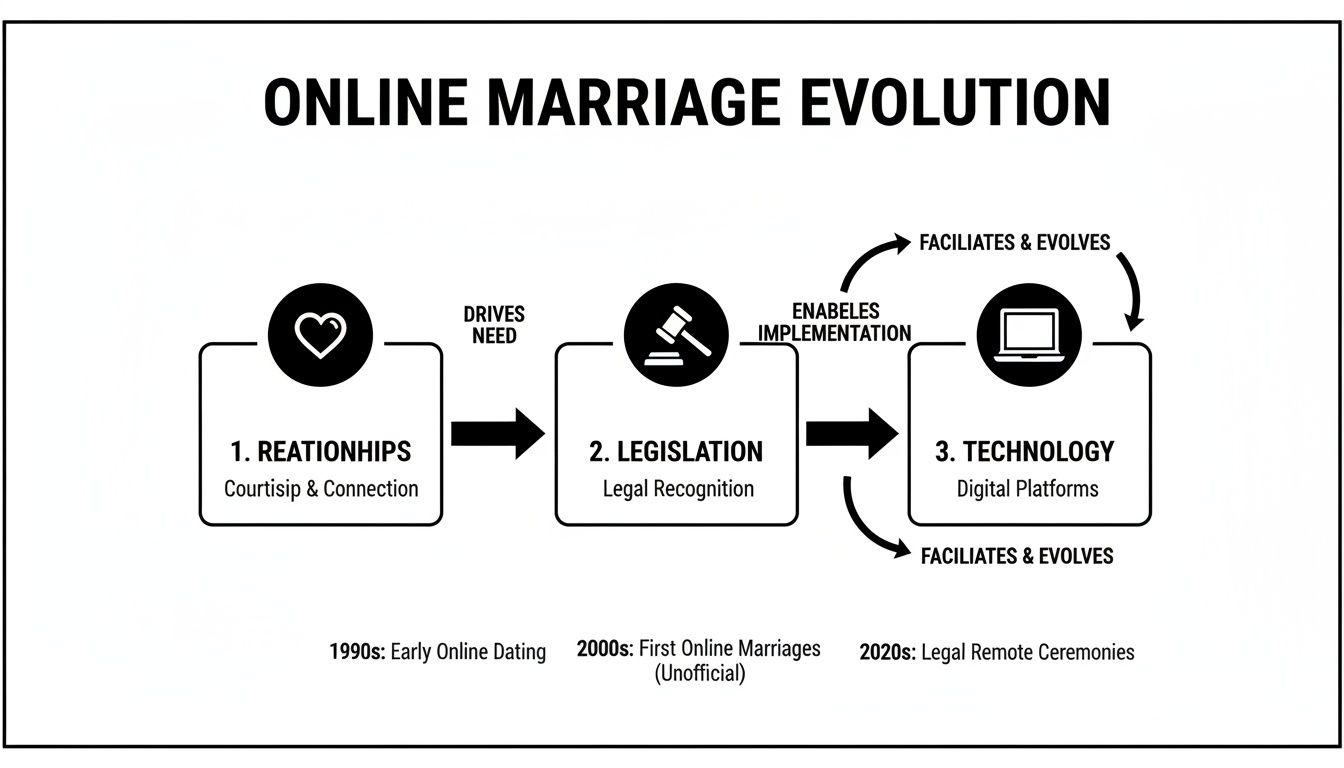
As you can see, each piece builds on the last, leading to a process that just makes sense for modern couples.
Step 1: Choose Your Service And Jurisdiction
Your first action is to pick a platform and the legal jurisdiction for your marriage. This is the most important decision you’ll make. Only a handful of U.S. states allow for a fully remote marriage process, so specialized services like Marryfromhome partner with these counties to make this option available to couples everywhere.
Your choice of service sets the tone for the entire experience. Look for a platform that offers:
- A Clear Process: You should know exactly what to do from the moment you land on their site.
- Full Support: Ensure a real team is available to answer your questions.
- Legal Expertise: Trust that the service knows the law inside and out and guarantees your marriage will be legitimate.
Nailing this first step ensures a wedding journey that’s exciting, not stressful.
Step 2: Complete The Online Application
Once you’ve picked your service, it’s time to fill out the official marriage license application. It’s all done online and is as straightforward as filling out any other secure digital form. You and your partner will need to provide basic information like full legal names, dates of birth, and current addresses.
Actionable Takeaway: This is the digital equivalent of going to the county clerk’s office. It’s the official start of your legal marriage, and you can do it from your living room.
Take a minute to double-check all information before you submit. A simple typo can cause delays, so a quick review now will save you a headache later.
Step 3: Verify Your Identity Remotely
To ensure everything is legal and secure, you and your partner will need to verify your identities. This typically happens over a quick video call with a representative or by securely uploading photos of your government-issued IDs.
Here’s what you’ll need to have ready:
- Valid Government-Issued ID: A passport, driver’s license, or national ID card.
- A Device with a Camera: Any smartphone, tablet, or laptop will work.
- A Stable Internet Connection: This ensures the video call is smooth and quick.
Think of this as the modern way of showing your ID to the clerk. It’s a quick but essential step to ensure your online marriage is 100% legitimate. If you want to dive deeper into the license part of the process, we have a whole guide on how you can get a legal marriage license online.
Step 4: Schedule And Attend Your Virtual Ceremony
With the legal paperwork sorted, you’re on to the main event—the ceremony! You’ll schedule a date and time that works for you. A licensed officiant, physically located in the legal jurisdiction (like Utah), will join you and your partner on a video call.
Feel free to invite friends and family to watch! They can join the video call from anywhere in the world. The ceremony itself is short and meaningful, usually lasting about 5-15 minutes. The officiant will guide you through the vows and then legally pronounce you married.
Step 5: Receive Your Official Marriage Certificate
After you’ve said your “I dos,” the officiant signs your marriage license and files it with the county. The county clerk’s office then processes everything and issues your official, government-backed marriage certificate. This is the exact same legal document you’d get from an in-person wedding.
Your chosen service will handle all the logistics. You’ll typically get a digital copy within a few days, and the physical hard copy will arrive in the mail soon after. This certificate is your official proof that the marriage is real, legal, and recognized everywhere.
Navigating Jurisdictions And Global Recognition
One of the first questions couples ask is, “If we get married online, will it actually be recognized where we live?” The simple answer is yes. Knowing how it works provides peace of mind, whether your partner is down the street or across an ocean.
The legal mechanism that makes this possible is straightforward. When you get married online through a service that partners with a U.S. jurisdiction like Utah, your marriage is legally recorded there. Its recognition then relies on solid legal principles that have been in place for decades.
How Your Marriage Is Recognized Across The United States
For couples within the U.S., recognition is guaranteed by the Full Faith and Credit Clause of the Constitution. This clause requires every state to respect the “public acts, records, and judicial proceedings of every other state.”
Think of it like your driver’s license. A license from Texas is valid for driving in Florida or New York. Your marriage certificate works the exact same way.
- You get legally married online through a county in a state like Utah.
- That county issues you an official, government-backed marriage certificate.
- Thanks to the Full Faith and Credit Clause, every other state in the U.S. must recognize your Utah marriage as 100% legal and valid.
This means you can use your marriage certificate for all official purposes—filing joint taxes, getting on your spouse’s health insurance, or updating your name—no matter which state you call home. You can learn more by checking out our guide on the specific U.S. states that allow online marriage.
Actionable Takeaway: A legal marriage in one state is a legal marriage in all states. An online ceremony performed by a licensed officiant in a recognized jurisdiction is just that—a legal marriage. No extra steps are needed for U.S. recognition.
Gaining Global Recognition For International Couples
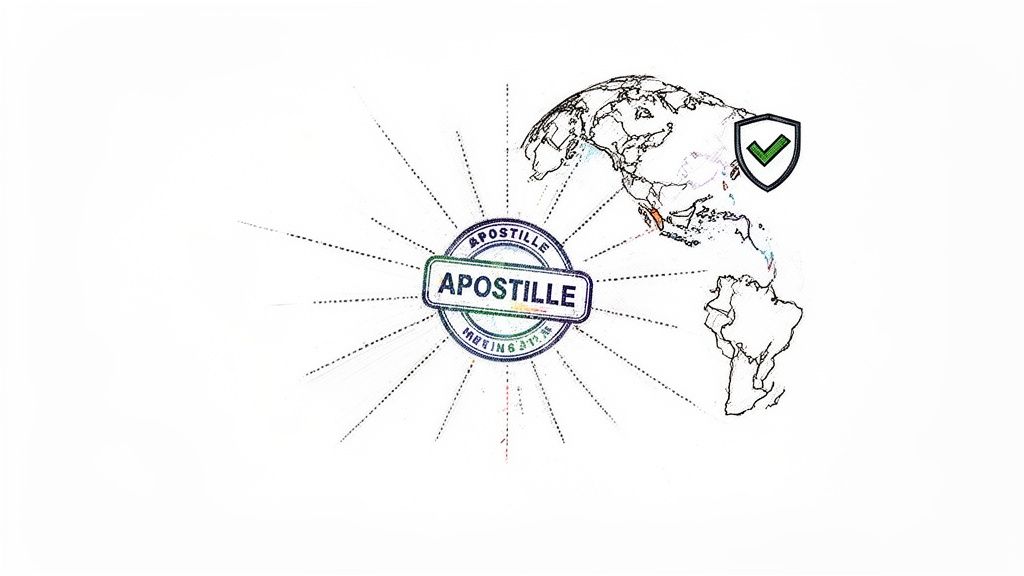
For international couples, a special certification called an Apostille is the key to global recognition. An Apostille is an official stamp that authenticates a public document, like your marriage certificate, for use in another country.
This system was established by the Hague Convention of 1961, an international treaty signed by over 120 countries. It was designed to simplify the process of getting foreign documents accepted abroad.
Here’s the process:
- Receive Your U.S. Marriage Certificate: After your online ceremony, you get the official marriage certificate from the U.S. county that issued it.
- Request an Apostille: Your online marriage service can almost always handle this step for you. The certificate is sent to the correct state authority.
- The Apostille is Attached: That office verifies the signature on your marriage certificate is legitimate and attaches the Apostille, proving your certificate is a genuine U.S. document.
- Use It Anywhere: Your Apostilled marriage certificate is now recognized as valid in any of the 120+ Hague Convention member countries, perfect for immigration, spousal visas, or any other legal process abroad.
This process is a game-changer for international couples, military personnel serving overseas, and anyone who needs their marriage to be legally ironclad on a global scale.
Domestic vs International Recognition
The table below breaks down the key differences between getting your marriage recognized in the U.S. versus in another country.
| Feature | Recognition in the U.S. | Recognition Internationally |
|---|---|---|
| Governing Principle | U.S. Constitution’s Full Faith and Credit Clause | Hague Apostille Convention |
| Required Document | Standard government-issued marriage certificate | Marriage certificate with an attached Apostille |
| Process | Automatic recognition in all 50 states | Requires the extra step of getting the Apostille |
| Primary Use Cases | Taxes, insurance, name changes, domestic benefits | Immigration, spousal visas, dual citizenship, foreign benefits |
Ultimately, whether your concern is state-to-state validity or international acceptance, the legal pathways are clear and well-established. A U.S.-based online marriage is a powerful, portable, and globally respected legal bond.
Busting the Biggest Myths About Online Marriage
It’s natural to be skeptical about new processes, especially for something as significant as getting married. Many couples ask if an online marriage is truly “real” or if it will be accepted for important life events like immigration. Let’s separate the myths from the facts.
The biggest misunderstanding is that an online wedding is just for show. People often confuse a legally-binding online marriage with a symbolic Zoom party, but they are completely different. A legal online marriage isn’t a gesture; it’s a formal, state-recognized union that results in an official, government-issued marriage certificate. This certificate is the exact same one you’d get from a courthouse.
Myth 1: It’s Not Valid for Immigration or Visas
This is the most critical myth to bust, and it is 100% false. Government agencies, including U.S. Citizenship and Immigration Services (USCIS), fully recognize online marriages. The only condition is that the marriage was legally performed and recorded in a recognized U.S. jurisdiction.
USCIS doesn’t care how you got married, only that you are legally married. They look for an official marriage certificate issued by a U.S. state or county. Since an online marriage performed through a state like Utah provides this exact document, it satisfies the legal requirements for spousal visas and other immigration processes. We’ve seen countless international couples successfully use their online marriage certificates to start their lives together in the U.S.
Myth 2: The Paperwork is Different or Less Official
Another common worry is that the documents you receive are a “lesser” version of what you’d get from a traditional wedding. That’s not the case. The marriage license application, the ceremony, and the final certificate are all official government processes and documents.
- The Application: You fill out the same official county marriage license application online.
- The Ceremony: A state-licensed officiant legally presides over your marriage, just as they would in a physical venue.
- The Certificate: The county clerk issues the exact same official marriage certificate, complete with a government seal.
The only real difference is the venue. Instead of being in the same room, you’re connected via secure video. The legal and administrative steps are identical.
Actionable Takeaway: Your certificate doesn’t say “Online Marriage” on it. It’s a standard, official marriage certificate from the issuing county. No one can distinguish it from one obtained via an in-person ceremony.
Myth 3: It’s a Legal Loophole That Might Get Shut Down
Getting married online isn’t a loophole; it’s a deliberate modernization of the law. Jurisdictions like Utah County intentionally built solid legal and tech frameworks to support remote marriage, making it more accessible.
This system is built on long-standing legal principles, like the Full Faith and Credit Clause of the U.S. Constitution, which ensures that documents from one state are honored in all others. This is a durable, established process, not a temporary workaround that’s going to disappear. When we answer “can you legally get married online?” with a confident “yes,” it’s because of legal evolution, not a temporary glitch.
A Few Common Questions About Getting Married Online
To wrap things up, here are answers to the most common questions we get from couples. This is the practical, need-to-know information to clear up any lingering doubts.
Do We Both Have to Be in the Same Place for the Ceremony?
No, and that’s one of the biggest benefits. You and your partner can be in completely different cities, states, or even countries.
As long as your officiant is physically located in a jurisdiction that allows for remote ceremonies (like Utah), your marriage is legally sound. You, your partner, and the officiant simply join a video call from wherever you are.
What Kind of Tech Do We Actually Need?
It’s much simpler than you might think. You don’t need any fancy equipment.
Here’s the checklist of what you need:
- A device with a camera and microphone, like a smartphone, tablet, or laptop.
- A reliable internet connection to ensure the video call is stable.
- A valid, government-issued photo ID to verify your identity.
The ceremony typically happens on a common platform like Zoom or Google Meet, which most people are already familiar with.
How Fast Can We Get Our Marriage Certificate?
The turnaround is surprisingly quick. Immediately after your virtual ceremony, the officiant signs the marriage license and files it with the county. You will usually receive a digital copy of your official marriage certificate within 24-48 hours.
The physical hard copy is then mailed and typically arrives in one to two weeks, depending on your location. This is a major advantage for couples who need their legal documents quickly for immigration, military benefits, or other time-sensitive matters.
Actionable Takeaway: An online marriage gets you the exact same legal certificate as a trip to the courthouse, but it’s often delivered faster and with far less hassle. This is your official, government-recognized proof of marriage.
Is This Really Valid for Military Benefits and Spousal Visas?
Yes, absolutely. A marriage certificate from a valid online ceremony is 100% recognized for all federal purposes. This includes military spousal benefits, adding a partner to health insurance, and crucial immigration processes like spousal visas (including the K-1 visa).
Government agencies like USCIS only care if the marriage is legal. Since your marriage is officially recorded in a U.S. jurisdiction and you receive a standard, government-issued certificate, it checks all their boxes. It is a real, legitimate marriage in every sense of the word.
Ready to make it official? With Marryfromhome.com, you can get legally married from anywhere in the world through a simple, secure, and fully supported process. Get started on your journey today!


