


Congratulations on getting married! Whether you had a big traditional wedding or a convenient online ceremony, the path to sharing a new last name starts right now. And it all begins with one critical piece of paper: your certified marriage certificate. This isn’t just a keepsake—it’s the legal key you’ll need for everything from updating your Social Security card to changing your name on your bank accounts.
The First Step Your Marriage Certificate
The single most important document in this entire process is your certified marriage certificate. Think of it as the legal proof required by every single government agency and financial institution you’ll deal with. Getting this first step right makes everything that follows so much smoother.
For couples who tie the knot online, it’s good to know that a marriage certificate from a legal online ceremony, like those we facilitate at Marryfromhome.com, is a fully valid, government-issued document. It carries the exact same legal weight as a certificate from an in-person wedding, so you can use it with total confidence for your name change.
Securing Your Certified Copies
After your online or in-person marriage is officially registered with the county clerk’s office, you can order certified copies. Here’s a common mistake I see people make: they only get one. You’re going to need multiple original, certified copies because photocopies just won’t cut it.
The Social Security Administration needs to see an original. Your local DMV will want one, too. And you can bet the U.S. Passport Agency also requires a certified copy. If you mail your only copy to one agency, you’ll be stuck waiting for its return before you can move on to the next, causing massive delays.
My best advice? Order three to five certified copies from the get-go. The small fee upfront is nothing compared to the time and headaches you’ll save by not having to re-order them down the line. If you got married online, check with the service provider on how to order these directly from the issuing county.
What to Check on Your Certificate
Before you even think about filling out forms, give your marriage certificate a very close look. A simple typo can bring the whole process to a screeching halt, and bureaucratic mistakes are way easier to fix at the source.
Check these details carefully:
- Full Legal Names: Make sure your name and your spouse’s name are spelled perfectly, including any middle names or suffixes.
- Date and Place of Marriage: Double-check that the ceremony date and location are listed correctly. For online marriages, this will be the location of the officiating county.
- Official Seal or Stamp: A certified copy must have a raised seal, an official stamp, or a watermark from the office that issued it (like the county clerk or vital records). This is what proves it’s authentic.
If you find an error, contact the county clerk’s office right away to get it corrected. A certificate with a misspelled name can be flat-out rejected by federal agencies, stopping you in your tracks. If you want to get a better handle on the documents you’re working with, our article explaining the differences between a marriage license and a certificate breaks it all down.
The Role of Your Certificate in the Name Change
Your marriage certificate is the foundational document that connects your old name to your new one. It doesn’t change your name automatically—what it does is give you the legal right to change it. You’ll be showing this document over and over again as proof.
When you go to get a new Social Security card, for instance, the agent will look at your birth certificate or passport and compare it to your marriage certificate to authorize the change. Without that certified proof, your request is a non-starter. Kicking off your name change journey with enough accurate copies in hand is truly the smartest move you can make.
Updating Your Social Security and Passport
Okay, you’ve got your certified marriage certificate in hand. This is a huge milestone, and now you’re ready to start making your new name official with the government. The first two big stops are federal: the Social Security Administration (SSA) and the U.S. Department of State for your passport.
Let’s start with the most important one. Updating your Social Security record is the absolute first move you need to make. Seriously, this part is non-negotiable.
Think of the SSA as the gatekeeper. Nearly every other agency, from the DMV to your bank, checks the Social Security database to verify your name and identity. If you skip this, you’ll hit a brick wall trying to update anything else.
Kicking Things Off with Social Security
First things first, you’ll need to fill out Form SS-5, which is the “Application for a Social Security Card.” You can easily find it on the SSA’s website and fill it out at home, but you can’t just submit it online. They need to see original documents to prove it’s really you.
Here’s what you’ll need to pull together:
- Proof of Name Change: Your original or certified copy of the marriage certificate. Whether you married online or in-person, this is the key document.
- Proof of Identity: An unexpired government-issued ID, like your current U.S. driver’s license, state ID, or passport.
- Proof of U.S. Citizenship: Your U.S. birth certificate or passport works for this.
With your completed Form SS-5 and these documents, you’ll either mail everything in or take it to an SSA office. I always recommend checking the SSA website for their latest instructions, as their policies on mail-in versus in-person can change.
And for the best part? It costs absolutely nothing. There is no fee to get an updated Social Security card with your new name.
Next Up: Your U.S. Passport
Once the SSA has processed your name change and your new card has arrived in the mail, it’s time to tackle your passport. This is crucial if you have any international travel on the horizon—the name on your plane ticket must match your passport exactly, or you’re not getting on that flight.
How you update your passport really depends on how old it is. The U.S. Department of State has a specific form and fee for different situations, so using the right one is key to avoiding headaches and delays.
A key takeaway here is sequencing. Always wait until your new Social Security card has arrived before starting the passport application. Attempting to do them simultaneously can lead to rejections and frustrating delays as agency databases won’t yet be in sync.
The path you take for your passport update is a major decision point in how to change your name after marriage. Let’s break down the scenarios.
Choosing the Right Passport Form
Figuring out which form you need is actually pretty simple once you know the rules. You’ll fall into one of three buckets, each with its own application and cost.
Scenario 1: Your Passport Was Issued Less Than a Year Ago If your passport is brand new (less than a year old), you’re in luck. This is the easiest and cheapest route.
- Form to Use: DS-5504, “U.S. Passport Re-Application Form.”
- What it’s for: This form is specifically for making corrections, including a name change from marriage, within one year of getting your passport.
- Cost: It’s free! You’d only pay extra if you need it expedited. Just mail in the form with your current passport, your certified marriage certificate, and one new passport photo.
Scenario 2: Your Passport Was Issued More Than a Year Ago This is where most people land. If your passport is over a year old but still valid (and meets a few other criteria), you’ll handle it like a standard renewal.
- Form to Use: DS-82, “U.S. Passport Renewal Application.”
- What it’s for: You’re essentially renewing your passport by mail, but with a name change.
- Cost: You’ll have to pay the regular passport renewal fees. You’ll mail the completed form, your current passport, your marriage certificate, a new photo, and the payment.
Scenario 3: You Don’t Qualify for the Others This is your path if your passport was lost, stolen, damaged, issued before you were 16, or is more than 15 years old.
- Form to Use: DS-11, “U.S. Passport Application.”
- What it’s for: You’re basically applying for a brand-new passport from scratch.
- Cost: You’ll pay the fees for a new passport application and the separate execution fee. This process can’t be done by mail; you have to go to a passport acceptance facility in person.
Choosing to change your name is a deeply personal decision, yet it’s rooted in long-standing social traditions. In the United States, a staggering 79% of women in opposite-sex marriages take their husband’s last name, according to a comprehensive 2023 Pew Research Center survey. This figure shows how powerful tradition remains, with only 14% keeping their maiden name and 5% hyphenating. Discover more insights from the full Pew Research Center report on marital name changes.
This process flow shows the simple, foundational steps to secure your marriage certificate, the document that makes all these updates possible.
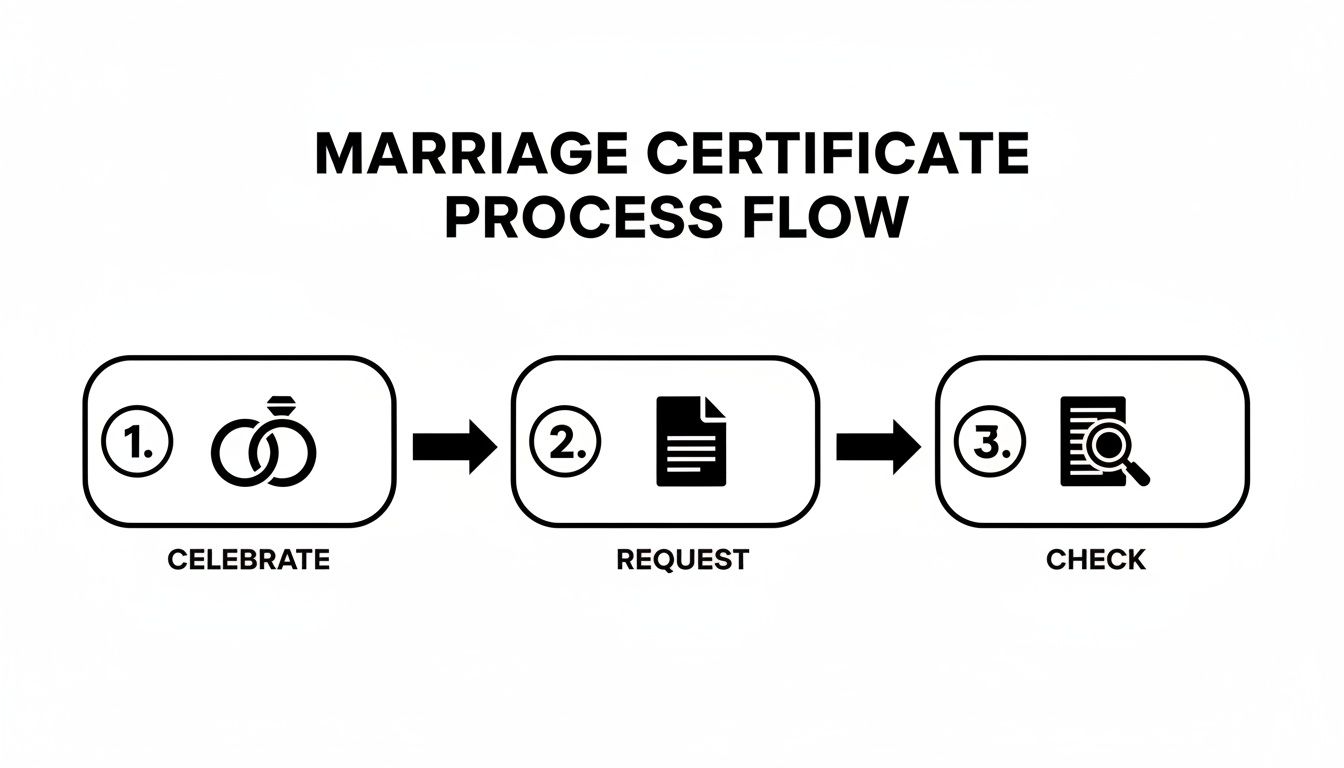
The visual underscores that success begins with celebrating, requesting official copies, and meticulously checking every detail for accuracy before moving on. And if you’re curious about the process for ceremonies conducted online, you can learn more about the legality of online marriage in our detailed guide.
Tackling Your State ID and Financials
Once your new Social Security card is on the way, the next big domino to fall is your state-issued ID. This is the moment things start to feel really official.
Think of your new driver’s license or state ID as the master key. It’s the primary photo identification that pretty much every bank, employer, and other institution is going to ask for. Without it, you’ll hit a wall trying to prove your new identity for everything from opening a joint bank account to signing important contracts.
Conquering the DMV
Let’s be honest, nobody loves a trip to the DMV. But if you walk in prepared, it can be surprisingly painless. The most important thing is having every single document ready to go before you leave the house.
Because you’ve already updated your Social Security info, the DMV’s system can ping the federal database to confirm your new name. It’s a neat little piece of bureaucratic magic that makes your life easier.
Here’s what you’ll almost certainly need to bring:
- Your Original Marriage Certificate: Get the certified copy, not just a photocopy. This is non-negotiable proof.
- Your New Social Security Card: If it’s already arrived in the mail, bring it. If not, the receipt from the SSA office might work, but it’s much smoother to just wait for the real card.
- Your Current Driver’s License or ID: They’ll take this and issue you a shiny new one.
- Proof of Address: Usually a couple of recent utility bills or bank statements will do the trick. Always check your state’s specific DMV website first, as requirements can vary.
Here’s a pro-tip from someone who’s seen it go wrong: wait at least 24 to 48 hours after the Social Security Administration confirms your name change before heading to the DMV. This gives the government databases time to sync up and saves you from the frustration of being told their system can’t find you.
Securing Your Financial Identity
With your new state ID in hand, you’re ready to align your financial world. This is more than just getting a new debit card with your married name—it’s about ensuring your identity is consistent everywhere. Any mismatches can trigger fraud alerts, create headaches with your credit report, or even lock you out of your own accounts.
Start with your main bank. Most will require you to pop into a branch in person. You’ll need to show your new driver’s license and your marriage certificate. This single visit should update all your accounts there, from checking and savings to any car loans or credit cards you have with them.
Once your primary bank is sorted, work your way down the list:
- Credit Card Companies: Just call the customer service number on the back of each card. They’ll walk you through their specific process, which often involves sending in copies of your documents.
- Investment and Retirement Accounts: Get in touch with your 401(k) administrator, brokerage firm, or any other investment platforms. These institutions are sticklers for security (as they should be!), so expect a formal verification process.
- Loan Providers: Don’t forget about student loans, your mortgage, or any other personal loans. A quick call to update your name ensures all future bills and important notices go to the right person.
This is also a great time to sit down with your spouse and talk about combining finances. If you appreciated the simplicity of getting married online, you might also like the idea of streamlining your financial life with joint accounts to tackle bills and savings goals together.
Notifying Employers and Insurers
Next up: your professional life. Your employer’s HR department is a crucial stop. They need to update your name for payroll, your W-4 tax form, and all your company benefits, like health insurance and retirement plans.
Usually, giving HR a copy of your new Social Security card and driver’s license is all it takes. This simple step keeps your paychecks coming and ensures your tax forms are correct at the end of the year.
Finally, do a quick audit of all your insurance policies:
- Health Insurance: If you’re on a company plan, HR usually takes care of this. If you have a private plan, you’ll need to contact the provider yourself.
- Auto Insurance: Your policy name must match your driver’s license and vehicle registration.
- Homeowners or Renters Insurance: Update this to make sure your policy accurately reflects your legal name.
While this list might seem long, tackling it step-by-step saves you from massive logistical headaches down the road. The decision to change your name is a personal one, blending tradition with individual choice. It’s a changing landscape, too. Research from The Female Quotient found that while 77% of married women globally take their partner’s last name, that number is shifting, with only 64% of unmarried women planning to do the same. You can dig into the data yourself in The Maiden Name Debate research report.
To help you stay organized, I’ve put together a checklist you can use to track your progress. It covers all the major places you’ll need to update your name.
Your Essential Name Change Checklist
Use this checklist to track every place you need to update your name after marriage, from government IDs to personal accounts.
| Category | Institution or Document | Typical Requirements |
|---|---|---|
| Government IDs | Social Security Administration (SSA) | Original Marriage Certificate, Proof of Identity, Completed Form SS-5 |
| U.S. Passport | Marriage Certificate, Current Passport, Completed Form DS-82 or DS-11, New Photo | |
| State Driver’s License/ID (DMV) | New SSN Card, Marriage Certificate, Current ID, Proof of Address | |
| Voter Registration | Varies by state; often can be done online or at the DMV | |
| Financial | Banks & Credit Unions | New State ID, Marriage Certificate |
| Credit Card Companies | Phone call or online form; may require faxing/mailing documents | |
| Investment & 401(k) Accounts | Specific forms, often requiring a notarized signature or certified documents | |
| Mortgage & Loan Providers | New State ID, Marriage Certificate | |
| Professional | Employer / Human Resources | New SSN Card, New State ID (for payroll, W-4, benefits) |
| Professional Licenses & Certifications | Contact the specific licensing board for their required forms | |
| Personal | Doctors & Medical Providers | Show your new ID and insurance card at your next visit |
| Insurance Providers (Health, Auto, Home) | New State ID, Marriage Certificate | |
| Utilities (Electric, Gas, Water, Internet) | Phone call or online account update | |
| Subscriptions & Memberships | Update your name in your online account profiles |
This might look like a lot, but just take it one category at a time. Before you know it, everything will be updated, and you’ll be fully settled into your new identity.
Updating Your Digital Footprint and Memberships
Once you’ve sorted out the big government and financial paperwork, it’s time to dive into the digital world. It’s easy to forget, but so much of our life is online these days, and making sure your digital self matches your new legal name is just as important as updating your passport.
Putting this off can create some seriously frustrating moments down the road. Imagine getting locked out of an account because you can’t verify who you are, or even having an airline cancel your tickets because the name doesn’t match your new ID. A little organization now saves a ton of headaches later.
Start with Your Communication Hubs
Your main email address is pretty much the key to your entire online kingdom. It’s what you use for password resets and identity checks for almost everything, so it’s the best place to start.
Begin by simply changing the display name on your email accounts (like Gmail or Outlook). This is a quick win. While creating a brand new email address with your new name is a whole other project, just updating the sender name gives you immediate consistency.
If you do decide to go for a new email address, make sure you set up forwarding from your old one. You don’t want to miss crucial notifications while you’re transitioning everything over.
Align Your Professional and Social Profiles
Next up is your online persona. You don’t want to confuse friends or professional contacts with a mix of old and new names floating around.
Your professional profiles are a big deal. On a platform like LinkedIn, your name is your brand. Jump into your account settings and update your first and last name so recruiters and colleagues can find the right you.
It’s just as simple for personal social media like Facebook, Instagram, or X (formerly Twitter). A quick trip to the settings page keeps everything consistent and helps your friends keep up.
One sneaky reason this is so important? Digital verification. More and more apps and services use your social media profile to double-check your identity. A name mismatch can cause a verification to fail when you really need it to work.
Secure Your Travel and Loyalty Programs
This is the one step you absolutely cannot skip, especially if you travel. Any accounts with airlines, hotels, or programs like TSA PreCheck or Global Entry are linked directly to your government ID.
Airlines are notoriously strict about this: the name on your ticket must be an exact match to the name on your passport or driver’s license. If you book a flight with your old name after you’ve updated your ID, you’re running a real risk of being denied boarding. It happens.
You’ll have to contact each program individually. They will almost certainly ask for a copy of your marriage certificate and your new ID. It’s a bit of a pain, but it’s nothing compared to the disaster of a cancelled trip.
Audit Your Subscriptions and Online Accounts
Last but not least, it’s time for a digital spring cleaning. Think of all the random places online where your old name is still living. It sounds like a lot, but you can tackle it systematically.
Jot down a list of your online accounts, focusing on these categories:
- E-commerce Sites: Your go-to shopping sites like Amazon or Target where payment and shipping info is saved.
- Subscription Services: Netflix, Spotify, the gym, your favorite monthly subscription box—they all have your name on file.
- Utility and Bill Pay Portals: Make sure your online accounts for your power, internet, and phone bills are all updated.
- Voter Registration: This is a crucial one. You can often update your voter registration online, or you can take care of it when you get your new driver’s license at the DMV.
Take an afternoon, put on some music, and work your way through the list. Updating your name in the “My Account” or “Profile” section for each service is the final step to getting your physical and online identities perfectly in sync.
Navigating Timelines, Costs, and Common Hurdles
Knowing what to expect—both in terms of time and money—can make the whole name change process feel a lot less intimidating. While most of the steps are pretty straightforward, a few common hurdles can trip you up if you aren’t ready for them.
Let’s be real: this isn’t an overnight thing. Government agencies move at their own speed, so getting a realistic timeline in your head is the best thing you can do for your sanity.
Setting Realistic Timelines
After you put in the request, your certified marriage certificates should land in your mailbox within one to two weeks, though this can definitely vary depending on your county. For online marriages, your service provider can often give you a precise estimate based on the issuing county.
Next up, the Social Security Administration. Once you mail your application, you can expect your new card to show up in about 7 to 14 business days. This is a big one, as you can’t even think about heading to the DMV without that new card in hand.
Passport processing times are the real wild card. Standard service can take anywhere from 6 to 8 weeks. If you’re in a rush, you can pay for expedited service, which might get it back to you in 2 to 3 weeks. Just be sure to plan any international travel way, way in advance!
Budgeting for the Name Change
Changing your name isn’t going to break the bank, but there are several small fees that can sneak up on you. It’s a good idea to have a rough budget so you don’t get any surprises.
Here’s a quick look at what you can expect to pay:
- Certified Marriage Certificates: These usually run between $10 and $30 per copy. Trust me, getting three copies from the get-go is a smart move.
- New Driver’s License/State ID: This fee changes from state to state, but it’s typically in the $20 to $50 range.
- Passport Book: If you’re just renewing, it’s $130. A brand-new passport application will cost $165. And that expedited service? That’ll be an extra $60.
These are just the big-ticket government fees. While lots of other updates (like with your bank) are free, it’s wise to budget around $200 to $300 total. That way, you’re covered for everything without feeling the pinch.
Troubleshooting Common Problems
Even the most organized person can hit a snag. The most common issue I see is a simple typo on the marriage certificate—a misspelled name or a wrong date.
If you spot an error, contact the county clerk’s office that issued it right away to get it amended. If you used an online marriage service, contact their support team—they can guide you on the fastest way to get it fixed with the county. Whatever you do, don’t try to push forward with an incorrect document. Agencies like the SSA will reject it flat out, and you’ll lose weeks.
Another classic issue is getting paperwork rejected because of missing info or bringing the wrong type of documents. Before you mail anything or drive to an office, double-check that every single field is filled out and that you have all the required original documents, not photocopies. This one simple check can save you a massive headache and a second trip. It’s also a good idea to review our guide on what you need for a marriage license to make sure everything was perfect from the very start.
The best way to avoid delays is to treat this whole thing like a mini-project. Use a checklist, keep all your documents together in a dedicated folder, and tackle one agency at a time. Trying to do it all at once is a recipe for chaos.
The tradition of changing your name after marriage is still going strong. For couples using services like Marryfromhome.com, figuring out the logistics is just part of the journey. The numbers back this up; a 2023 Pew study showed 79% of women in U.S. opposite-sex marriages took their husband’s name. A YouGov poll from 2025 found that 67% of U.S. married women had changed theirs. For the millions who legally update their IDs, starting with Social Security is always the right first move. By knowing the timelines, costs, and potential roadblocks, you can make the whole transition a lot smoother.
Your Name Change Questions, Answered
Even with the best checklist, changing your name can feel like a puzzle with a few missing pieces. Let’s tackle some of the most common questions that pop up during the process, so you can move forward with confidence.
How Long Do I Have to Change My Name After Marriage?
The good news is there’s no legal stopwatch ticking. In the U.S., you can change your name right after the wedding, a few months later, or even years down the road. The decision is entirely personal.
That said, getting it done sooner rather than later can save you a world of logistical headaches. For instance, you can update a U.S. passport for free, but only within one year of your marriage date. Taking care of it promptly keeps all your legal documents, travel plans, and bank accounts in sync.
Can I Still Travel with My Old Passport?
This is a big one, and the short answer is: it’s risky. Airlines are sticklers for matching names. The name on your government-issued ID must be an exact match to the name on your boarding pass. If it isn’t, you could be turned away right at the gate.
The safest bet is to hold off on booking international travel under your new name until you have your new passport in hand. If you absolutely have to travel while you’re in that in-between phase, carry a certified copy of your marriage certificate. Just know that it’s not a guaranteed workaround and a sympathetic gate agent is never a sure thing.
If you’ve already booked a big international honeymoon, the smartest move is often to wait until you get back to start the name change process. Enjoy your trip without any passport stress!
Do I Need to Change My Name on My House Title or Mortgage?
Yes, this is definitely a box you’ll want to tick. Updating your name on property titles and mortgage documents creates total legal clarity. It makes future transactions, like selling your home or refinancing, much, much simpler.
The process is often called “retitling” and usually means filing a new deed with your county recorder’s office. You’ll need your certified marriage certificate and your new government ID. Your best first step is to call your mortgage lender and a local real estate attorney or title company to get the specific rundown of their procedures.
I Got Married Online. Is My Marriage Certificate Still Valid?
Absolutely. A marriage certificate from a legally-officiated online ceremony, like those we facilitate at Marryfromhome.com, is 100% valid and official.
It’s issued by a U.S. county clerk’s office and carries the exact same legal authority as a certificate from a traditional, in-person wedding. You can confidently use it as your official key to update your Social Security card, passport, driver’s license, and everything else. Your online ceremony is legally binding, and so is the paperwork that proves it.


