


So, you’ve tied the knot. Congratulations! Whether you celebrated with a huge party or a quiet online ceremony, the “I dos” are done. Now for the other big part: making your new name official. If you’re looking at a mountain of paperwork and wondering, “Where on earth do I even start?”—you’re in exactly the right place.
A name change kit after marriage isn’t some pre-packaged box you buy. It’s a plan. An organized set of forms and a clear checklist to get you through the administrative stuff without pulling your hair out. This guide is your kit, designed especially for couples who chose the modern path of an online wedding, and we’re getting started right now.
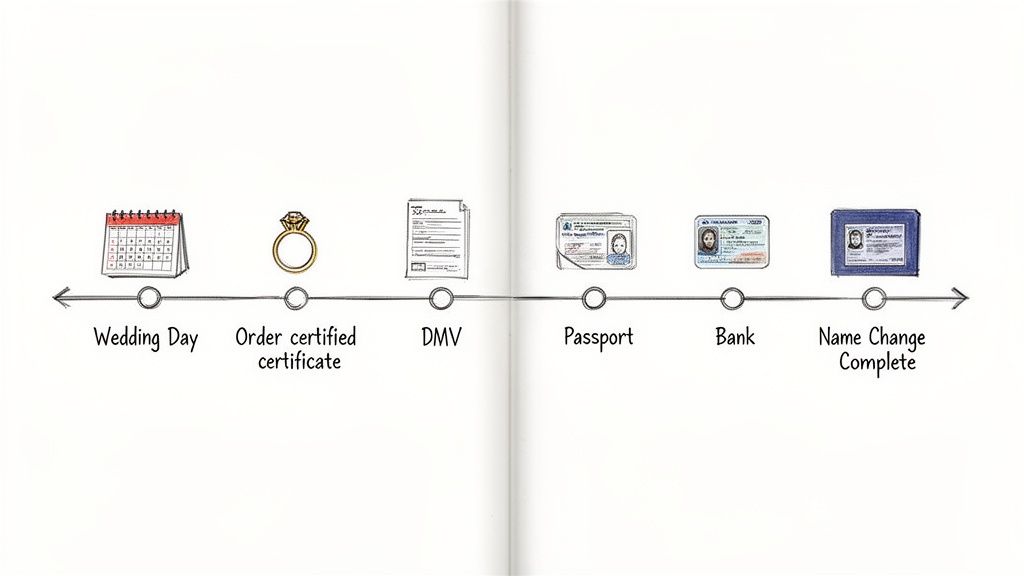
Why Everyone Still Changes Their Name
Changing your name after the wedding is still incredibly common, and that’s actually good news for you. Because so many people do it, government agencies and banks have a well-oiled system in place. You’re not forging a new path; you’re just following a clear, established trail. For those who married online, this is great news—the process is identical and just as recognized as a traditional wedding.
Just how common is it? A 2023 Pew Research Center study found that a massive 79% of women in opposite-sex marriages still take their husband’s last name. Only a small fraction, about 14%, keep their name, while just 5% choose to hyphenate. You can see the full breakdown in the Pew Research report on marriage name change trends.
Key Takeaway: You are not alone in this. The process is straightforward and predictable once you know the steps. The secret is to tackle it one piece at a time so it never feels overwhelming.
The Big Three: Your Core Name Change Mission
At its heart, the entire name change process is about proving your identity has legally changed. This means your journey starts with a few key government agencies before you can touch anything else.
Think of it as a domino effect. You have to knock over the first, most important domino to get the rest to fall.
- Social Security Administration (SSA): This is your first stop. Period. Your name with the SSA is the foundation for everything else. Without this, you can’t update your license, passport, or bank accounts.
- Department of Motor Vehicles (DMV): Your driver’s license or state ID is your primary photo identification. It has to match your new legal name.
- U.S. Department of State: Got a passport? Planning to travel internationally? Updating it is non-negotiable if you want to avoid a major headache at the airport.
Once these three are done, you’ll use your new Social Security card and driver’s license as proof to update everything else—from your credit cards and bank accounts to your job’s payroll and the name on your electric bill.
Your golden ticket for this whole process is your certified marriage certificate. It’s the one document that acts as legal proof of your name change, making all the other steps possible. In fact, getting this certificate is the final step of the online marriage process itself. If you’re curious how it all connects, check out our guide on what you need for a marriage license.
Quick-Start Name Change Action Plan
This table is your starting line. Focus on these three critical updates first, and the rest of the process will be much smoother.
| Priority | Agency | Action Required | Essential Document |
|---|---|---|---|
| 1 (First!) | Social Security Administration (SSA) | File Form SS-5 (Application for a Social Security Card) | Certified Marriage Certificate |
| 2 | Department of Motor Vehicles (DMV/RMV) | Update your driver’s license or state ID card in person | New Social Security Card & Certified Marriage Certificate |
| 3 | U.S. Department of State | Update your passport by mail (Form DS-5504, DS-82, or DS-11) | New Driver’s License & Certified Marriage Certificate |
With these three foundational updates handled, you’ll have the official documents needed to breeze through the rest of your checklist. Ready to dive into the details? Let’s go.
Obtaining Your Certified Marriage Certificate
Let’s talk about the single most important piece of paper you’ll need for your name change: your certified marriage certificate. This isn’t just a formality; it’s the golden ticket. It’s the official, legal proof that every single agency—from the Social Security Administration to your local bank—will demand before they update your name.
Think of it this way: without this document, your name change process is stuck in park.
A lot of couples get tripped up on this. The beautiful, decorative certificate your officiant handed you after the ceremony? That’s a wonderful keepsake for your scrapbook, but it’s not a legal document. You need the official version issued by the county clerk’s office, the one with a raised seal or other fancy security features.
How to Order Copies After an Online Wedding
If you tied the knot with an online service, the process is incredibly simple. Even though you weren’t physically in a courthouse, your marriage was legally registered in a specific U.S. county. You’ll just need to order your certified copies directly from that county’s Clerk of Court or Vital Records office.
For couples who used a service like Marry From Home, we make sure you know exactly which county handled your registration. You can usually order the copies you need right from the county’s official website. This is a huge advantage for online marriage—you don’t have to travel back to a specific courthouse; you can manage it all remotely. You can get the full rundown on how this works in our guide to getting a legal marriage certificate online.
Pro Tip: Don’t order just one. Seriously. Order 3 to 5 certified copies right from the start. They typically cost between $10 and $30 per copy, and paying that small fee upfront will save you a world of headaches later.
Why Multiple Copies Are Not Optional
Ordering only a single copy is a classic rookie mistake, and it can stall your entire name change for weeks. Some places, like the U.S. Passport Agency, will require you to mail in an original certified copy that you won’t get back right away. Others, like the bank or DMV, will want to see an original in person.
If you’re juggling these tasks with just one certificate, you’ll be stuck waiting for it to be mailed back before you can even think about the next item on your list.
Here’s a real-world example we see all the time: a newlywed heads to the bank, new driver’s license in hand, along with a high-quality photocopy of her marriage certificate. The teller has to turn her away because they can only accept a certified original. Now she has to go home, order a new copy from the county, wait for it to arrive, and then go back to the bank all over again.
Having a few copies on hand means you can work on several updates at once. You can send one off for your passport while you take another one with you to the DMV. This simple strategy is a key part of an effective name change kit after marriage. It’s a small investment in your time and, more importantly, your sanity.
The 3 Pillars of a Legal Name Change
Once you have that certified marriage certificate, you’re ready to get down to business. This is where your new name becomes official. The whole thing really boils down to three major updates, what I like to call the “pillars” of your name change: Social Security, your state ID, and your passport.
You have to do them in this exact order. Each step unlocks the next one, so think of updating Social Security as the first domino you need to push over.
Deciding to change your name is a logistical journey, not just a romantic one. A 2025 YouGov survey really shined a light on this, finding that while 80% of women in opposite-sex marriages still take their husband’s surname, a new trend is emerging. Women aged 18-49 are twice as likely as those over 50 to keep their names, often because they’ve built up a professional identity. Even so, a huge 73% of that younger group still decides to make the switch. You can dig into more of these stats in the full YouGov poll results.
Pillar One: The Social Security Administration
Your first stop is the Social Security Administration (SSA). No exceptions. The name the SSA has on file is the master key the U.S. government uses to identify you for everything from taxes to employment. Until you change it here, you can’t touch your driver’s license, passport, or even your bank accounts.
You’ll start by filling out Form SS-5, the “Application for a Social Security Card.” It’s a simple two-page form you can download right from the SSA’s website.
Next, you’ll need to gather original or certified copies of documents to prove a few things:
- Your Legal Name Change: This is your certified marriage certificate.
- Your Identity: A current, unexpired driver’s license, state ID, or passport works perfectly.
- Your U.S. Citizenship: Grab your U.S. birth certificate or passport.
With your completed Form SS-5 and documents in hand, you can either mail everything in or visit an SSA office. For couples who got married online and might be far from the county that issued the certificate, mailing is often a lifesaver. Just make sure you use a shipping method you can track.
This quick diagram shows the simple flow of getting that all-important marriage certificate you’ll need for this process.
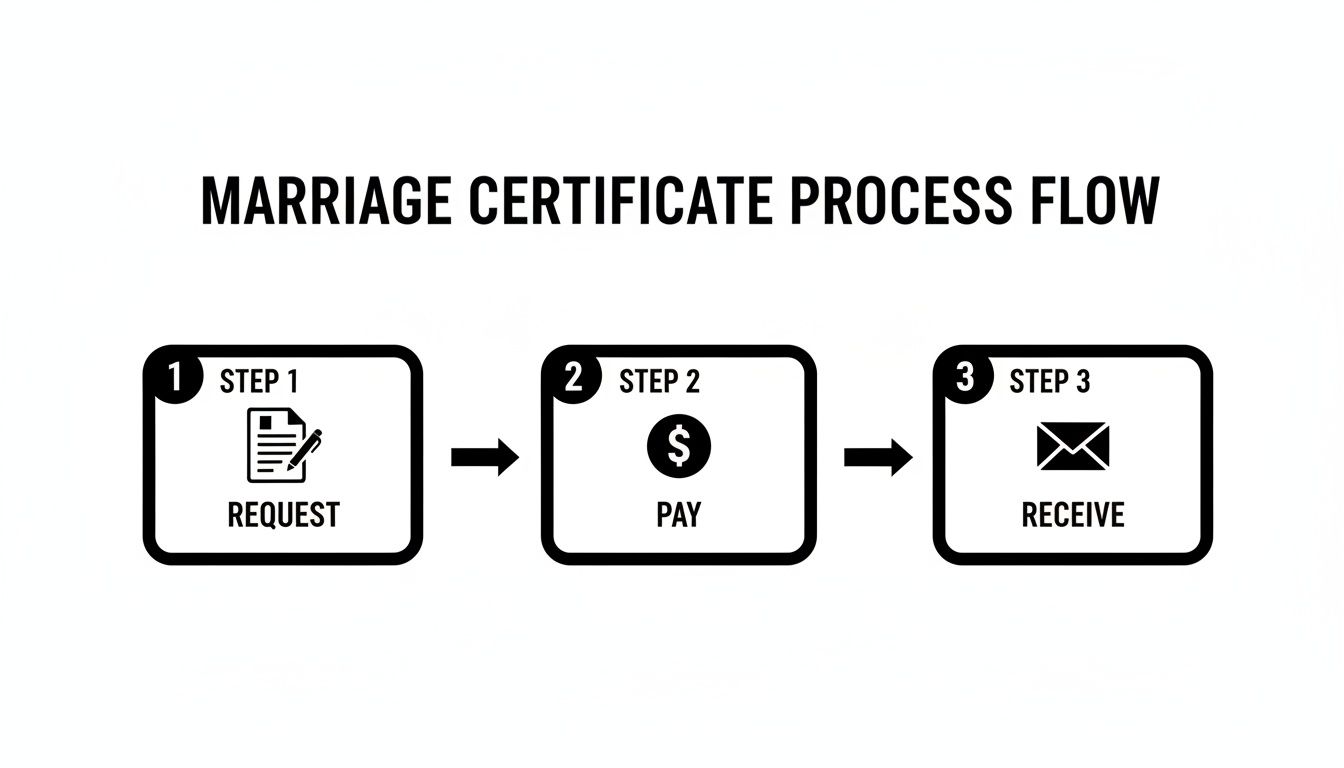
As you can see, getting this core document is a pretty straightforward first move before you even think about heading to the SSA.
Key Takeaway: The entire Social Security name change service is completely free. The SSA won’t charge you a dime to update your name or send you a new card. Your new card, with your new name but the same Social Security number, should show up in your mailbox in about 7-14 business days.
Pillar Two: The DMV or State ID Agency
When that new Social Security card arrives, it’s time for Pillar Two: updating your driver’s license or state ID. This is the photo ID you’ll flash for almost everything, so getting it updated is a huge step forward.
You absolutely have to do the SSA update first. Most DMV systems are directly linked to the SSA database and will check your name change electronically. If you show up at the DMV before the SSA has processed your update, they’ll almost certainly send you away.
What you need varies a lot by state, so your first move should be to check your state’s DMV website. They’ll have a checklist of documents, which nearly always includes:
- Your new Social Security card (or other proof of the change).
- Your certified marriage certificate.
- Your current driver’s license.
- Proof of residency (a recent utility bill or your lease agreement usually works).
Most states will require you to show up in person for this, since they need to snap a new photo. To avoid spending your whole day there, see if you can book an appointment online. This is a total game-changer and can turn a dreaded ordeal into a quick 30-minute trip. To learn more, check out our guide that breaks down the differences between a marriage license and a certificate.
Pillar Three: Your U.S. Passport
The last government pillar to tackle is your U.S. Passport. If you’re planning any international travel—especially for a honeymoon—the name on your ticket has to match your passport exactly. A mismatch can get you denied at the boarding gate, which is a nightmare for any traveler.
The form you’ll need depends on how old your current passport is. This is where a good name change kit after marriage plan can save you some real time and money.
Scenario A: Your Passport Was Issued LESS Than One Year Ago You’re in luck! If your passport is less than a year old, you get to use Form DS-5504, “Application for a U.S. Passport Name Change.”
- Cost: It’s free! There’s no processing fee for this.
- What to Send: The filled-out DS-5504, your current passport, your certified marriage certificate, and one new passport photo.
Scenario B: Your Passport Was Issued MORE Than One Year Ago If your passport is over a year old, you’ll have to use Form DS-82, which is the standard “U.S. Passport Renewal Application.”
- Cost: You’ll have to pay the regular passport renewal fee, which is currently $130 for the book.
- What to Send: The completed DS-82, your current passport, your certified marriage certificate, the renewal fee, and one new passport photo.
For both scenarios, you’ll mail your application. Since you handled your wedding online, you’re likely comfortable with mail-in processes. Routine processing can take 6-8 weeks, while expedited service (costs extra) gets it done in 2-3 weeks. And don’t panic—your supporting documents, like your marriage certificate, will be mailed back to you, but they often arrive in a separate envelope from your new passport.
Updating Your Financial and Personal Records
Once you’ve tackled the “big three”—Social Security, the DMV, and your Passport—you’re officially on the home stretch. Now it’s time to sync the rest of your life with your new last name.
This part is less about navigating legal mazes and more about a systematic sweep of all your financial and personal accounts. Think of it as the final, crucial step in putting your name change kit after marriage to work. Skipping these updates can cause some real headaches, like a rejected paycheck, a flagged credit card, or a mess when filing an insurance claim. Let’s get everything aligned.
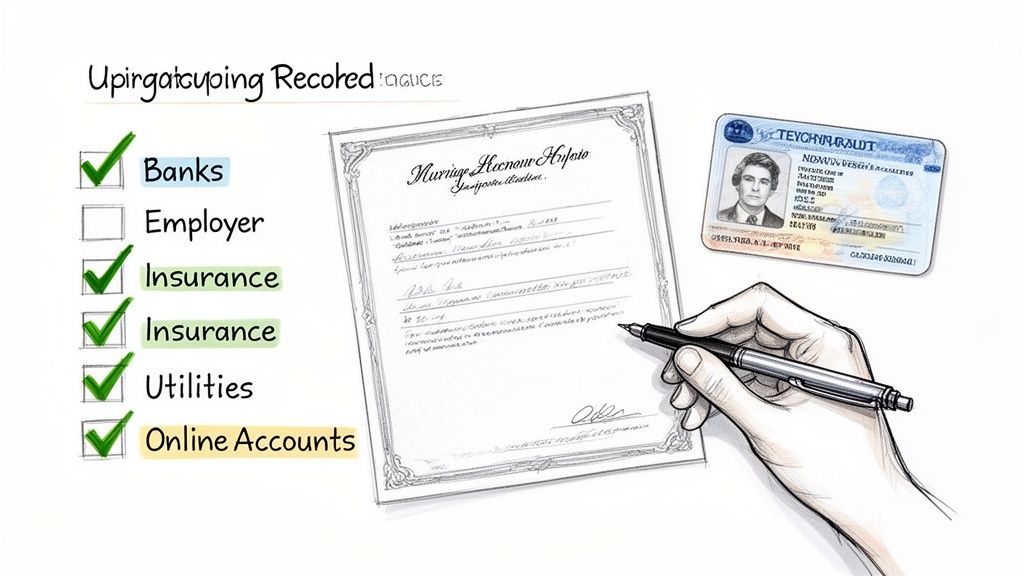
Securing Your Financial World
Your financial accounts should be at the top of your list. A name mismatch can cause transactions to fail or even trigger fraud alerts. Your new driver’s license and certified marriage certificate are the golden tickets here.
For banks and credit unions, the best move is to go in person. Just walk into a branch with your new photo ID and a certified copy of your marriage certificate. This lets a bank employee verify everything right there, update your profile, and order new debit cards and checks on the spot. It’s the quickest way to get it all done.
Credit cards are usually a bit easier, often handled online or over the phone. Most major card companies have a pretty simple process:
- Log into your online account and find the “profile” or “account settings” area.
- Many will let you upload a digital copy of your new ID and marriage certificate directly—a perfect option for those comfortable with online processes.
- If that’s not an option, a quick call to customer service is usually all it takes to get the ball rolling.
A huge reason to do this quickly is to make sure your credit history transitions seamlessly to your new name. You want lenders reporting consistently under one name to keep your credit score strong.
Updating Your Employment and Benefits
Next up: your professional life. The name your employer has on file impacts your payroll, health insurance, and retirement accounts. This is a must-do to ensure your paychecks clear and your benefits stay active without any hiccups.
Set up a quick chat with your Human Resources (HR) department. They’ll tell you exactly what they need, but it’s almost always:
- A copy of your new Social Security card.
- A copy of your updated driver’s license.
Once HR updates your name in their main system, it should trickle down to payroll and most benefits providers. It’s still a good idea to double-check, though. Make sure your health insurance, dental, vision, and retirement fund accounts (like a 401(k)) all reflect the change.
Your Comprehensive Notification Checklist
This final bucket covers pretty much everything else that makes up your daily life. While some of these might seem small, checking them off systematically prevents annoying mix-ups later on.
To make this easier, here is a detailed checklist you can use to track every account and entity you need to update. Just print it out and check things off as you go!
Comprehensive Name Change Notification Checklist
| Category | Account/Entity | Status (Checkbox) |
|---|---|---|
| Federal & State | Social Security Administration | ☐ |
| U.S. Passport | ☐ | |
| State Driver’s License/ID | ☐ | |
| Voter Registration | ☐ | |
| Vehicle Title & Registration | ☐ | |
| Global Entry / TSA PreCheck | ☐ | |
| Financial | Banks (Checking & Savings) | ☐ |
| Credit Card Companies | ☐ | |
| Investment & Brokerage Accounts | ☐ | |
| Retirement Accounts (401k, IRA) | ☐ | |
| Mortgage Lender / Landlord | ☐ | |
| Auto Loan Provider | ☐ | |
| Student Loan Provider | ☐ | |
| Employment | Human Resources / Payroll | ☐ |
| Professional Licensing Boards | ☐ | |
| LinkedIn & Professional Profiles | ☐ | |
| Insurance | Health, Dental & Vision Insurance | ☐ |
| Auto Insurance | ☐ | |
| Homeowners / Renters Insurance | ☐ | |
| Life Insurance | ☐ | |
| Household & Personal | Utility Companies (Electric, Gas, Water) | ☐ |
| Internet & Cable Provider | ☐ | |
| Cell Phone Provider | ☐ | |
| Doctor’s Offices & Pharmacy | ☐ | |
| Post Office (USPS) | ☐ | |
| Loyalty & Rewards Programs | ☐ | |
| Online Shopping Accounts | ☐ | |
| Social Media Accounts | ☐ | |
| Will & Estate Documents | ☐ |
This checklist is your roadmap to a complete transition. It might look long, but tackling a few items each day makes it totally manageable.
Breaking Down the Personal Admin List
Here’s a little more detail on some of the key items from that list.
Insurance Policies Beyond your employer’s health insurance, you’ll need to contact other providers directly.
- Auto Insurance: Call your agent to update your policy. A name mismatch could seriously complicate a claim if you get into an accident.
- Homeowners or Renters Insurance: A similar phone call is all it takes to align your policy with your legal name.
- Life Insurance: Update the name on your own policy and take a moment to see if you need to update your beneficiary information, too.
Household and Personal Accounts This list can feel endless, but you can knock it out over a week or two.
- Utilities: Gas, electric, water, and internet providers. Most let you do this online or with a quick phone call.
- Mortgage or Lease: This is a big one. Contact your mortgage lender or landlord to see what their specific process is. They will definitely require your new ID and marriage certificate.
- Doctor’s Offices and Pharmacy: Just let the front desk know at your next visit. This ensures your medical records and prescriptions are accurate.
- Professional Licenses: If you have a license for your career (like nursing, law, or real estate), get in touch with the issuing board to update it.
The decision to change a name often means balancing professional identity with personal administration. For many career-focused women, this step can cause the most pause. However, for the 53% of U.S. births from 2015-2019 to married women, having a matching family surname simplifies life’s logistics. This is especially true since 20% have a second child within 24 months, making a unified family name an administrative advantage. You can discover more insights about these name change considerations on YouGov.com.
Your Downloadable Name Change Kit and Final Tips
You’ve waded through the official paperwork, and now you’re on the home stretch. This is where we pull everything together to make the rest of your name change journey as smooth as possible. We’ve bundled all the essential tools into a single, handy download—your official name change kit after marriage.
Think of this as your personal command center for the entire process. It’s designed to keep you from feeling overwhelmed, breaking down what feels like a mountain of a task into a series of small, manageable steps.
(Coming Soon! Your Downloadable PDF Kit) We’re putting the finishing touches on a complete PDF kit just for you. It will feature a master checklist, a tracker for your certified marriage certificates, and even pre-written sample letters for notifying banks, employers, and other organizations. Check back soon to grab your all-in-one name change sidekick!
Final Tips for a Smooth Transition
With your checklist ready to go, a few last pieces of advice can make a world of difference. This is especially true for the little things that are easy to overlook. Getting the government documents sorted is one thing, but making sure your new identity is reflected everywhere else takes a bit of planning.
You’re not alone in wanting a simpler way to do this. The demand is huge—services like MissNowMrs.com have helped over 400,000 brides navigate this exact process. For couples who use Marryfromhome.com, having a clear plan is a lifesaver for updating critical documents like passports and Social Security cards. It lets you go from the excitement of your online ceremony to tackling the bureaucracy without missing a step. You can read more about the business of name changes on Fortune.com.
Managing Your Digital Identity
These days, your name lives in countless places online. Don’t let your digital footprint lag behind! As someone who opted for a digital-first wedding, you’ll appreciate the importance of keeping your online profiles consistent.
- Professional Networks: Start with LinkedIn. It’s your public professional face. A great tip is to add your former name to your profile summary or headline so old colleagues and contacts can still find you easily.
- Email Signature: This one is so easy to forget! Update your work and personal email signatures right away. It’s a small change that signals your new name to everyone you correspond with.
- Social Media: Run through your social accounts—Instagram, Facebook, X, and anything else you use. Updating your name helps prevent confusion and keeps your friends and family in the loop.
Be Patient With Yourself and the Process
Finally, remember to give yourself some grace. Changing your name is a marathon, not a sprint. You’ll probably have moments of frustration, like a form you missed or a piece of mail that shows up with your old name months down the road. It’s all part of the journey.
Embracing a new name can be an emotional shift, too, and that’s completely okay. It’s more than just paperwork; it’s a change in your identity. Acknowledge those feelings, but also focus on the excitement of starting this new chapter. By following a clear plan, you free yourself up to enjoy what really matters: your new life together.
Your Name Change Questions, Answered
Once you’ve tied the knot, the final details of changing your name can bring up a few last-minute questions. We’ve gathered the most common ones we hear, especially from couples who started their new life with an online ceremony.
Can I Change My Name After an Online Marriage?
Yes, you absolutely can. A marriage performed online through a service like Marry From Home is 100% legally identical to a wedding that happens in person.
You’ll receive an official, county-issued marriage certificate. That single document is your golden ticket to start the name change process with the Social Security Administration (SSA), the DMV, your bank, and everyone else.
The procedure is exactly the same, whether you said your vows in a courthouse or from your living room. The only thing that matters is that your marriage is legally registered and you have that certified proof in hand.
How Long Does This Whole Process Really Take?
While government processing times can vary, it’s wise to budget about 2-3 months for the entire name change journey from start to finish. It’s best to think of it as a domino effect.
- Your new Social Security card is usually the first piece of the puzzle and often arrives in 1-2 weeks.
- Getting your updated driver’s license can take another 1-4 weeks, depending on your state’s processing speed.
- Updating your passport is the longest part of the trip, typically taking 6-12 weeks for routine service.
The most important thing to remember? Start with the Social Security Administration as soon as you have your marriage certificate. Every other update depends on getting that first step done.
Do I Have to Change My Name? What Are My Options?
Not at all. Changing your name is a personal choice, not a legal requirement. Many people choose to keep their name for professional or personal reasons, and that’s perfectly fine. It’s a decision for you and your partner to make together.
If you are considering a change, you have a few popular options beyond simply taking your spouse’s last name:
- Hyphenate both names (like Carter-Knowles).
- Move your current last name to become a middle name.
- Create an entirely new blended name (this one is more complex and usually requires a court order).
This guide focuses on the most common path of taking a spouse’s name, but the choice is completely yours.
The biggest mistake we see couples make is ordering only one certified copy of their marriage certificate. Some agencies require you to mail in an original, which can halt all your other progress. We strongly recommend ordering at least 3-5 certified copies as soon as your marriage is registered. It will save you so much time and frustration down the road.
Will I Need a Court Order to Change My Name?
For a standard name change after getting married, a court order is not necessary.
Your certified marriage certificate is the official legal document that gives you the authority to change your name on all your IDs and accounts. A court order is generally only required for more complicated situations, like creating a new last name from scratch or for changes that aren’t related to marriage. Think of your marriage certificate as your all-access pass.


