


Yes, getting married online is absolutely legal, provided you follow a clear, actionable process. The legality of your virtual wedding depends entirely on where your marriage license is from and how your ceremony is conducted.
Think of it this way: your marriage isn’t happening in some vague internet cloud. It’s legally taking place in a specific, real-world jurisdiction—like a county in Utah—that has authorized the entire process to be done remotely. Understanding this is the first step to confidently planning your own legal online wedding.
This guide provides the actionable insights you need to navigate the process smoothly and ensure your virtual wedding is legally solid and recognized everywhere.
How Can an Online Marriage Be Legally Real?
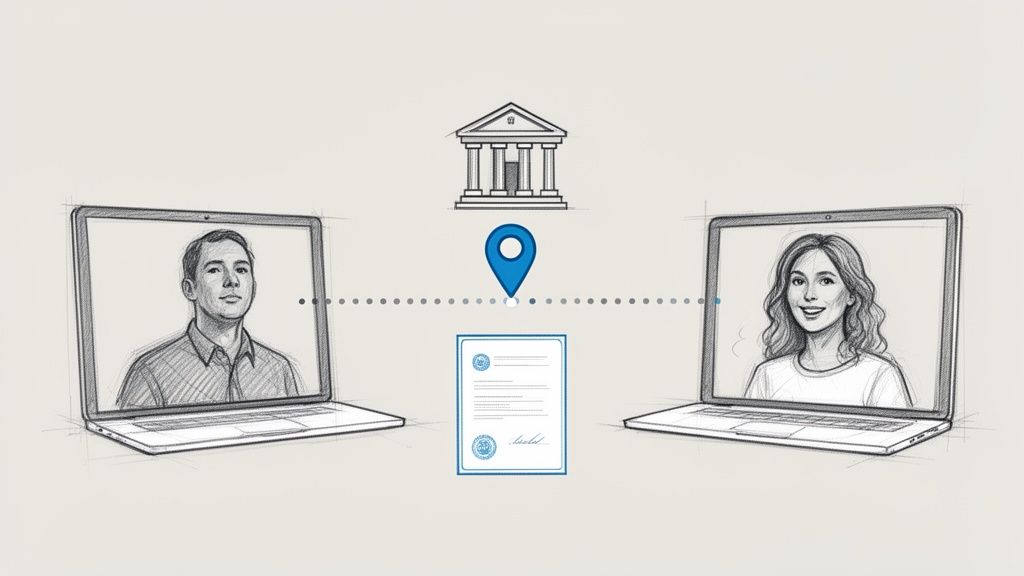
If you’re asking, “is online marriage actually legal?” the answer is a big yes. The legal principle is simple: your marriage is governed by the laws of the place where your officiant is physically located during the ceremony—not where you and your partner are.
This principle is called lex loci celebrationis, a legal term meaning “the law of the place where the marriage is celebrated.” It’s why a couple from France can fly to Las Vegas, get married, and have that marriage be valid back home. For your virtual wedding, the “place of celebration” is the U.S. state where your authorized officiant conducts the ceremony over video. This makes it a legally sound event.
The Utah Model: A Blueprint for Your Online Wedding
Utah provides the best working example of this principle. The state’s laws were specifically designed to allow marriage ceremonies to be performed remotely. This means an officiant in a Utah county can legally marry you and your partner over a video call, no matter where you are in the world, as long as you meet all of Utah’s legal requirements.
This forward-thinking approach provides a practical solution for:
- International Couples: Overcome visa challenges or travel bans to get legally married.
- Military Personnel: Marry your partner back home while deployed overseas.
- Couples with Mobility Issues: Tie the knot without the need for difficult travel.
Your marriage license will come from a Utah county, the ceremony will be led by a Utah-approved officiant, and the final marriage certificate is an official, government-issued Utah document that you can use anywhere.
To help you get started, here’s a breakdown of the key steps you need to take to make your online marriage official.
Your Actionable Online Marriage Checklist
This table outlines the essential legal steps for a valid online marriage, so you know exactly what actions to take.
| Legal Component | What It Means for Your Online Marriage | Key Action Required |
|---|---|---|
| Jurisdiction of Celebration | The physical location of your officiant determines the laws that govern your marriage. | Action: Choose a service that operates in a jurisdiction that permits fully remote ceremonies, like Utah. |
| Marriage License | This is the official government permission slip for you to get married. | Action: Apply for and receive a valid marriage license from the correct jurisdiction before your ceremony. |
| Authorized Officiant | The person conducting your ceremony must be legally empowered to do so by the jurisdiction. | Action: Verify that your chosen officiant is legally recognized and registered in the state/county issuing your license. |
| Valid Ceremony | The event itself must meet the legal requirements of the jurisdiction (e.g., clear intent, vows). | Action: Participate in a live video conference ceremony where you and your officiant can see and hear each other clearly. |
| Registration of Marriage | After the ceremony, the signed license must be filed with the government to create a legal record. | Action: Ensure your officiant files the completed marriage license with the issuing county clerk’s office. |
By following these steps in the correct order, your online marriage will be just as legally sound as one that happens in a physical courthouse or church.
The legal magic of an online marriage is that its validity is determined by the laws of the officiant’s location, not the couple’s. By choosing a jurisdiction like Utah, you anchor your virtual ceremony in a solid, globally recognized legal framework.
Ultimately, your online wedding is not just a symbolic gesture. It’s a formal legal event grounded in a specific, recognized jurisdiction. This foundation is what gives your marriage certificate full legal weight, making your union official.
How a Virtual Wedding Becomes Legally Binding
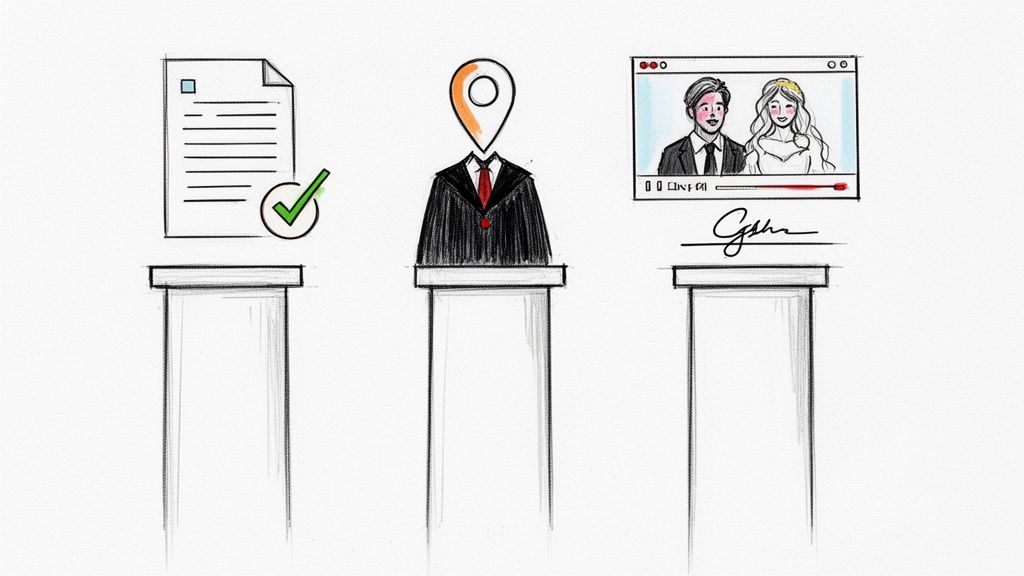
The idea that a video call can create a legally binding marriage might seem futuristic, but the legal logic is straightforward. It works just like signing a business contract with someone overseas via a notarized video conference—it’s 100% binding because all legal requirements are met, just through a screen.
The legality of online marriage doesn’t come from new “internet laws.” Instead, technology allows you to meet long-standing legal standards for being “present” and showing intent. Here are the three pillars that turn a video call into a state-recognized union.
The First Pillar: The Government-Issued Marriage License
Before you can say “I do,” you need official permission from the government. This comes in the form of a marriage license, and it is the absolute foundation of your marriage. Without a license, there is no marriage.
Actionable Insight: The license must come from a jurisdiction that allows the entire process—from application to ceremony—to happen remotely.
This involves more than just filling out a web form. The county clerk’s office must be equipped to:
- Verify your identities remotely: You’ll typically upload photos of your government IDs and may have a brief video chat with a clerk.
- Process the application digitally: You and your partner can complete all paperwork without ever setting foot in a government building.
Once issued, this digital license is the official document your officiant will sign after your ceremony. To learn more about this crucial first step, you can learn more about how to get a legal marriage license online in our detailed guide.
The Second Pillar: A Legally Authorized Officiant
The person who pronounces you married holds real legal authority. For your online marriage to be valid, your officiant must be physically located in the same state or county that issued your license at the time of the ceremony. This is non-negotiable.
Actionable Insight: An officiant in California, for example, cannot legally solemnize a marriage using a license from Utah. Your officiant acts as an official agent of the state, and their authority is tied to their physical location. They will witness your consent and officially sign the license, certifying the marriage.
The Third Pillar: A Live Virtual Ceremony
The final piece is the ceremony itself. The law requires the couple and the officiant to be “present.” For an online marriage, “presence” means everyone is together in real-time on a live video conference.
Actionable Insight: This cannot be a pre-recorded video or an email exchange. You, your partner, and the officiant must be able to see and hear each other simultaneously.
A legally recognized virtual ceremony is a live, interactive event. It’s designed to confirm clear and present intent from both partners in front of an authorized officiant, fulfilling the same legal standards as a traditional, in-person wedding.
During this live event, the officiant will confirm your identities, hear you state your intent to marry, and watch you exchange vows. This real-time interaction proves you’re both entering into the marriage freely. After your vows, the officiant digitally signs the license and returns it to the county clerk. Once it’s registered, your marriage is officially and legally binding.
Where You Can Legally Get Married Online
When planning your online marriage, the most important factor is where the marriage is legally performed. Not all states permit remote ceremonies. Understanding the legal landscape is your first practical step, allowing you to focus on jurisdictions that have established, reliable systems for remote couples.
This knowledge will save you from wasting time on states that only seem to offer online options but have hidden in-person requirements. Instead, you can focus on places built to serve couples just like you, whether you’re in different states or on opposite sides of the world.
Utah: The Global Hub for Online Marriage
Utah is the undisputed leader in online marriage. Thanks to its progressive laws, you can complete the entire process—from applying for the license to the ceremony and receiving the certificate—100% remotely.
This isn’t a temporary measure; it’s a permanent, robust system. A couple with one partner in Japan and the other in Germany can get legally married through a Utah county without ever visiting the United States.
Why Utah is your best choice:
- No Residency Requirement: You don’t have to be a Utah or U.S. resident. Your location is irrelevant.
- Global Accessibility: Couples from any country can legally marry, provided the marriage is also legal in their home country.
- Streamlined Process: Jurisdictions like Utah County have perfected the online system, making it incredibly efficient for international and long-distance couples.
This means a certified Utah officiant can legally marry you and your partner in a “Zoom wedding” that is recognized worldwide. It is the most reliable and straightforward path for a truly remote ceremony.
New York and Other Pioneering States
While Utah leads the way, other states have also embraced digital marriage. New York, for example, made remote wedding ceremonies permanent after seeing their success during the pandemic. Like Utah, it offers a fully online path to a legal marriage.
Actionable Insight: Your key task is to distinguish between states that are partially online and those that are fully remote. You must confirm that every single step can be completed from your computer.
The most critical distinction is between states that offer online applications and states that offer fully remote marriages. The former requires an in-person step, while the latter allows you to complete everything from application to certificate issuance online.
Several states have emerged as leaders in offering true, end-to-end digital marriage services. These states let couples apply for, complete, and submit their marriage license entirely online, with no in-person visits required.
The Critical Difference: Fully vs. Partially Online States
This is where many couples get stuck. A quick search might show that dozens of states let you apply for a marriage license online. However, that is often just the first step.
Many of these “partially online” states require you to physically appear at the county clerk’s office to verify your identity and pick up the license. For any long-distance or international couple, this is a dealbreaker.
The true leaders offer a completely digital experience. Knowing which states these are is crucial. It allows you to avoid the logistical nightmare of planning a trip just to sign a document. If you’re ready to explore your options, our guide on U.S. states that allow online marriage provides the details you need. Focusing on these key jurisdictions will ensure your path to a legal online marriage is smooth and genuinely remote.
Your Step-by-Step Checklist for a Legal Online Marriage
Now, let’s turn knowledge into action. This is your practical playbook for making an online wedding a legal reality, broken down into a simple, actionable checklist.
Follow these steps to ensure your virtual ceremony is smooth, secure, and—most importantly—legally solid.
Step 1: Choose the Right Jurisdiction
This is your most critical decision. The state or county you choose will issue your marriage license, no matter where you are. Get this right, and everything else falls into place.
Actionable Choice: For most couples, especially those in different countries or states, Utah is the gold standard. Its laws are built for fully remote weddings, with no residency or citizenship requirements, making it the most accessible and reliable option.
Step 2: Gather Your Essential Documents
Once you’ve chosen a jurisdiction, get your paperwork ready. The government clerk needs to verify your identity with official documents.
You’ll need:
- A valid, unexpired government-issued photo ID: A passport, driver’s license, or state ID card.
- Proof of age: Your photo ID usually covers this.
- Application information: Full legal names, dates and places of birth, and parents’ names.
Pro Tip: Before you even start the application, double-check the expiration dates on your IDs. An expired ID is one of the most common hiccups that can delay the whole process.
This flowchart lays out the process, highlighting the crucial difference between states that offer a truly remote marriage and those that still have in-person requirements.
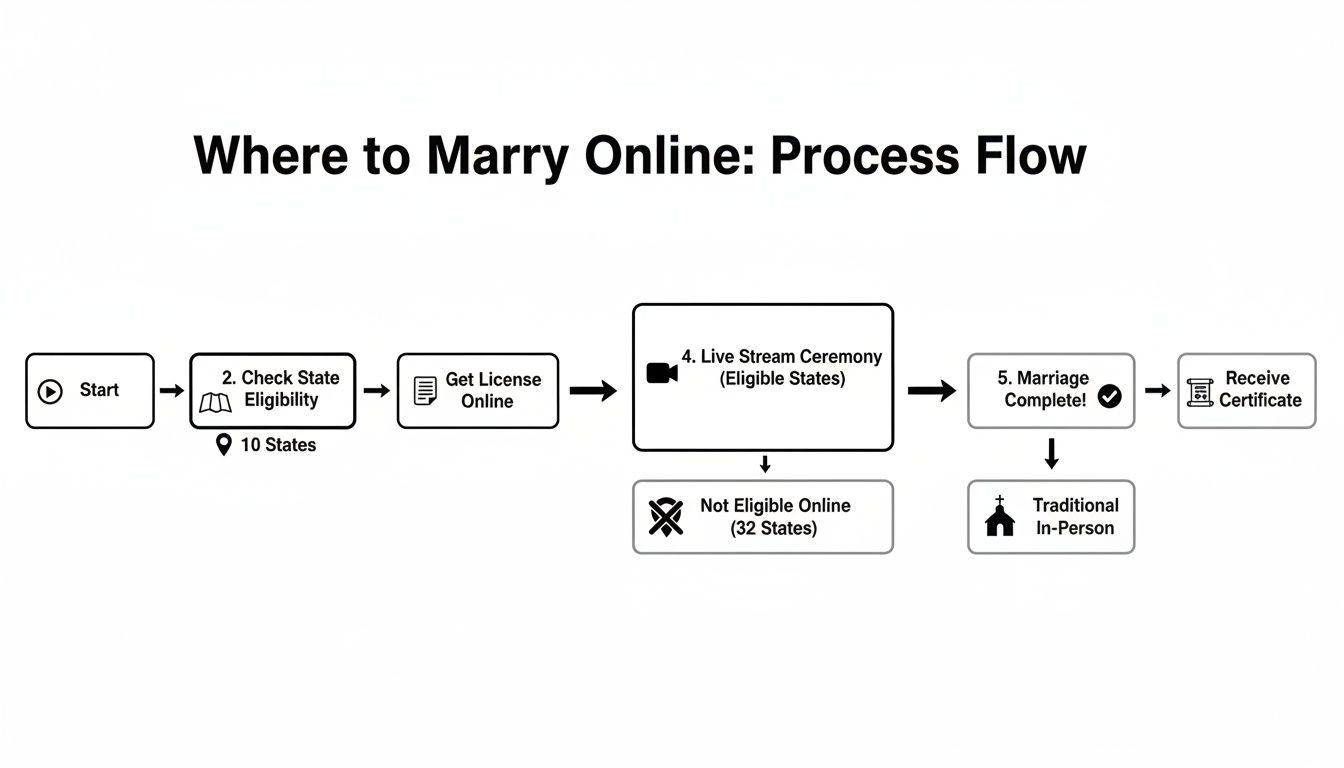
The key takeaway is to stick with states offering a 100% digital experience to avoid unexpected travel and roadblocks.
Step 3: Navigate the Online Application
With your documents scanned, go to the county clerk’s official online portal to apply for your marriage license.
The forms are straightforward, but be meticulous. Fill out your personal details and upload clear images of your IDs. Ensure every piece of information matches your documents exactly to prevent delays.
Step 4: Pass Your Virtual Identity Verification
After submitting the application, you must prove your identity. This is the digital equivalent of appearing at the clerk’s office.
You and your partner will join a brief video call with a clerk’s office representative. They’ll ask you to hold your IDs up to the camera for real-time confirmation. It’s a quick but essential security check.
Step 5: Book a Certified Officiant
Your marriage license is permission to get married; the officiant makes it official. You must choose an officiant legally certified to perform marriages in the jurisdiction that issued your license.
Actionable Tip: A Utah marriage license requires an officiant who is not only authorized by Utah but is also physically in Utah during your ceremony. Reputable online marriage services provide a roster of certified officiants, simplifying this step.
Step 6: Conduct the Virtual Ceremony
It’s time for the main event. Your ceremony must be a live video conference where everyone—you, your partner, and the officiant—can see and hear each other clearly.
Tips for a smooth ceremony:
- Test your tech: Check your internet connection, camera, and microphone a day or two before.
- Find a quiet space: Choose a well-lit spot where you won’t be interrupted.
- Prep your witnesses: If required, ensure they have the video link and know their role.
The officiant will guide you through your vows and pronounce you married. This live interaction fulfills the legal requirement for “presence.”
Step 7: Receive Your Digital Marriage Certificate
After you say “I do,” the officiant digitally signs your marriage license and sends it back to the county clerk. Once the clerk registers it, your marriage is officially on the books.
You will typically receive a digital copy of your official, government-issued marriage certificate by email, sometimes within hours. This PDF is a legal document. You can also order certified paper copies for immigration, banking, or name changes.
Common Mistakes That Can Invalidate Your Online Marriage
Getting married online is modern and efficient, but it’s crucial to avoid common legal pitfalls. A small oversight can lead to significant problems, potentially jeopardizing the validity of your marriage. Think of this as your pre-flight safety check to ensure your union is legally sound.
Knowing these potential issues is key. A simple mistake, like using an officiant in the wrong state or failing to check recognition requirements in your home country, can invalidate the entire process. By avoiding these errors, you can ensure your virtual wedding is rock-solid and recognized everywhere.
Choosing an Officiant in the Wrong Location
This is the single most critical—and damaging—mistake you can make. The legality of your online marriage depends on the fact that the wedding legally occurs where your officiant is physically located. If your marriage license is from Utah, your officiant must be physically present in Utah when conducting the ceremony.
An officiant in another state or country lacks the legal authority to solemnize a marriage using a Utah license. This error can render the entire ceremony legally void.
How to avoid this mistake:
- Verify Credentials: Ask for proof that your officiant is legally registered and in good standing in the state issuing your license.
- Confirm Their Location: Get direct confirmation that your officiant will be physically inside the correct state during your ceremony. A reputable online marriage service will guarantee this.
Failing International Recognition Checks
For international couples, assuming a U.S. marriage certificate will be accepted everywhere without question is a major risk. While a marriage legal in a U.S. state is generally recognized globally, some countries have specific registration requirements that can cause complications.
For example, a Lebanese court case highlighted this issue. After initially being rejected, a judge ultimately upheld a couple’s Utah Zoom wedding by applying the locus celebrationis principle—meaning the law of the place of celebration (Utah) determines its validity. You can read more about the legal precedent set by this Utah Zoom wedding case in Lebanon.
Actionable Step: Before you begin, contact the local government office, embassy, or consulate in your home country. Ask them exactly what is required to register a foreign marriage certificate from the specific U.S. state you plan to use.
Overlooking Witness Requirements
Not all states require witnesses for online ceremonies, but if yours does, their “presence” must meet legal standards. They must join the live video call, actively watch the ceremony, and be able to clearly see and hear you, your partner, and the officiant.
Common witness-related mistakes include:
- A witness not being present on the live call.
- A witness joining with faulty audio or video, preventing proper observation.
- The officiant forgetting to confirm the witness’s identity during the call.
Actionable Tip: If your ceremony requires witnesses, treat their role seriously. Ensure they have the correct link, test their technology beforehand, and confirm they are ready to be fully present for the live event.
Frequently Asked Questions About Online Marriages
Diving into the world of online marriage is exciting, but it’s totally normal to have questions pop up as you get closer to the big day. Let’s walk through some of the most common things couples ask, giving you clear, practical answers so you can move forward with confidence.
How Much Does an Online Marriage Typically Cost?
One of the most appealing aspects of getting married online is the cost. It’s significantly more affordable than a traditional wedding. An online marriage eliminates major expenses like venue rentals and catering, focusing solely on the legal ceremony.
Most couples can expect the total cost for a fully remote marriage to be between $200 and $800. This package typically includes:
- Government Marriage License Fee: This non-negotiable fee goes directly to the county clerk’s office, usually between $50 and $100.
- Officiant Services: The fee for a legally authorized officiant to conduct your ceremony.
- Platform or Agency Fee: This covers the service that manages the process for you—guiding your application, scheduling the ceremony, and ensuring all paperwork is filed correctly.
While the legal process is affordable, online weddings also offer flexibility for personalization. The Knot Worldwide’s 2026 Real Weddings Study highlighted a trend of couples wanting to create unique, memorable celebrations. Online marriage provides an accessible legal foundation, freeing up your budget for personal touches. You can read more about the trends shaping modern weddings to see how it all connects.
Are Witnesses Required for a Virtual Wedding Ceremony?
The answer depends entirely on the state issuing your marriage license. Witness requirements vary, so it’s a crucial detail to confirm.
Actionable Insight: Utah, a leader in online marriage, does not require any witnesses. This is ideal for couples seeking a private ceremony or wanting to avoid coordinating schedules across time zones.
However, a state like New York may require one or two witnesses. If they are needed, they must join the live video call and be able to clearly see and hear the entire ceremony. They are legally confirming that you both entered into the marriage willingly.
Key Takeaway: Always, always double-check the witness rules for your specific jurisdiction before your ceremony. Any reputable online marriage service will make this crystal clear right from the start.
Is My U.S. Online Marriage Certificate Valid Internationally?
Yes, in most cases, a marriage certificate issued by a U.S. state is recognized worldwide. This is due to international agreements and the legal principle that a marriage valid where it was celebrated is valid everywhere. Since your online marriage legally occurs in a specific U.S. county, you receive a legitimate U.S. legal document.
Actionable Step: To ensure your certificate is accepted by a foreign government for processes like visas or residency, you will almost certainly need an Apostille.
- What’s an Apostille? It is an official certificate attached to your marriage license by the Secretary of State’s office. It authenticates the document for use in countries that are part of the Hague Apostille Convention.
- Why do I need it? It serves as an extra layer of verification, telling foreign officials that your marriage certificate is a legitimate, government-issued document from the U.S.
Most online marriage services can handle the Apostille process for you for an additional fee, saving you significant time and effort.
Can Two Non-U.S. Citizens Get Married Online Through a U.S. State?
Absolutely. This is one of the most significant benefits of the U.S. online marriage system, particularly in states like Utah. You do not have to be a U.S. citizen or resident to get legally married through a U.S. state that offers this service.
States like Utah have no citizenship or residency requirements. This means two people from any country can be legally married by a Utah-certified officiant over a video call, even if neither has ever been to the United States. The marriage is 100% legal in the U.S., and you receive an official U.S. government document.
This has become an essential solution for many, including:
- International Couples: Bypass travel restrictions and long visa waits.
- Couples in Countries with Restrictive Marriage Laws: A path to marriage for those facing legal, religious, or social barriers at home.
- Spouse Visa Applicants: A legal U.S. marriage certificate is a critical component for immigration. Learn more in our guide on how online marriage impacts spouse visa applications.
The process for international couples is identical. You will use your valid passports for identification, complete the online application, and attend your virtual ceremony. The result is a legally binding marriage recognized around the globe.


