


Getting married online is a thrilling, modern way to start your new life. The legal stuff, like sorting out your marriage application, is usually pretty clear. But what comes next—actually merging your financial lives—can feel like navigating a maze without a map, especially if you’re starting your marriage from a distance.
Think of this as the first big project you tackle together as a married couple. It’s about way more than just bank accounts. You’re building trust, dreaming up shared goals, and designing a financial system that actually works for both of you, day in and day out, no matter where in the world you are.
This conversation is a game-changer, especially for couples who start their journey with an online marriage. You might be dealing with long distances, different currencies, or even separate financial systems, making crystal-clear communication and digital tools non-negotiable from the get-go.
Your First Financial Decisions as a Married Couple
Before you jump into any big money moves, the absolute first step is to schedule a dedicated video call and have a completely honest, no-holds-barred conversation.
Laying the Financial Foundation
Forget about picking a bank for a minute. It’s time for total transparency. This is where you lay all your financial cards on the table—the good, the bad, and the just plain complicated. The goal is to create a shared, digital snapshot of where you both stand so you can move forward as a true team.
Here’s what your first big money talk needs to cover:
- Income and Assets: How much does each of you bring in, and in what currency? What’s in your savings, investments, or retirement accounts? Do you own any property? Use a shared spreadsheet to track this.
- Debts and Liabilities: This means everything. Student loans, credit card balances, car payments, personal loans. Hiding debt is one of the fastest ways to break trust, so get it all out there.
- Credit History: Pull your credit scores and reports. If you’re from different countries, understand that your credit histories won’t merge. This gives you a clear picture of your combined borrowing power and flags any surprises.
- Financial Habits: Be honest. Are you a meticulous budgeter or more of a free spirit with your spending? Do you love saving, or does money burn a hole in your pocket? Understanding these core tendencies now will save you a world of arguments later.
This initial talk isn’t about judging past mistakes. It’s about building a foundation of honesty. This is the bedrock of trust you’ll need to manage your money as a unified force, especially when you’re not physically together yet.
Once everything is out in the open, you can begin to figure out how you want to structure your day-to-day finances. Most couples land on one of three main paths: going all-in with joint accounts, keeping everything completely separate, or creating a hybrid system that blends both.
There’s no magic “right” answer here. The best choice is the one that feels right for your relationship and aligns with your shared goals. This first conversation is what gives you the clarity to pick your path with confidence.
Choosing Your Financial Path: The Three Core Strategies
Figuring out how to merge your financial lives after getting married isn’t a one-size-fits-all deal. The best setup for you, especially if you got married online, really boils down to your personalities, what financial baggage (or treasure!) you’re each bringing into the marriage, and what you want to build together.
Let’s break down the three main ways couples tackle this.
The All-In Approach: Fully Joint Accounts
This is the classic, “what’s mine is yours” model. Every paycheck goes into one shared checking account, and every bill, coffee, and vacation gets paid from that same pot. You’re operating as a single financial unit.
For a lot of couples, this creates a powerful sense of teamwork and total transparency—every dollar truly is “our” dollar. It’s especially effective if you’re aggressively chasing big goals together, like saving for a spouse visa or a down payment on a home. When all your money is pooled, tracking progress is a breeze.
The flip side? Some people can feel a loss of personal freedom. If you’re still living in different places, this approach requires immense trust and can be logistically tricky with international banking.
The Yours and Mine Strategy: Separate Accounts
At the other end of the spectrum, you have the option to keep everything completely separate. You each have your own bank accounts, just like before you were married, and there are no joint accounts at all.
You’ll need a clear system for splitting shared expenses like visa application fees or funds for future travel. This could be a straight 50/50 split or you might decide to contribute proportionally based on your incomes, using a shared spreadsheet or budgeting app to keep track.
This approach is all about independence. It’s a popular choice for couples who marry later in life, come in with significant personal assets, or are navigating the complexities of international finances. The good news is that it cuts down on arguments over little personal purchases. The challenge, though, is that it can sometimes lead to financial secrets and requires a lot of coordination to manage shared goals, which can feel like an endless negotiation.
Keeping money separate in marriage is becoming more common. Data from the U.S. Census Bureau shows a major shift in how couples have managed their money over the past 30 years.
The Hybrid Model: A Blend of Both Worlds
This is easily the most popular route these days, and for good reason—it offers a fantastic compromise. It’s the best of both worlds, really.
Here’s the breakdown:
- You open one joint checking account that’s just for shared household expenses or goals. Think saving for relocation, joint travel, or future rent.
- You both agree on how much to contribute to this joint account each month, potentially using an international money transfer service.
- You each keep your own separate, personal accounts for everything else. This is your money for local expenses, hobbies, or personal savings goals.
This setup gives you the unity you need to work towards shared goals smoothly while still preserving the freedom to manage your own money without having to ask for permission. It’s a game-changer for minimizing fights over discretionary spending.
Think about an international couple saving to close the distance. The hybrid model lets them contribute to a joint “relocation fund” without clashing over day-to-day spending in their respective countries.
To help you figure out which path feels right, this decision tree lays out the options visually.
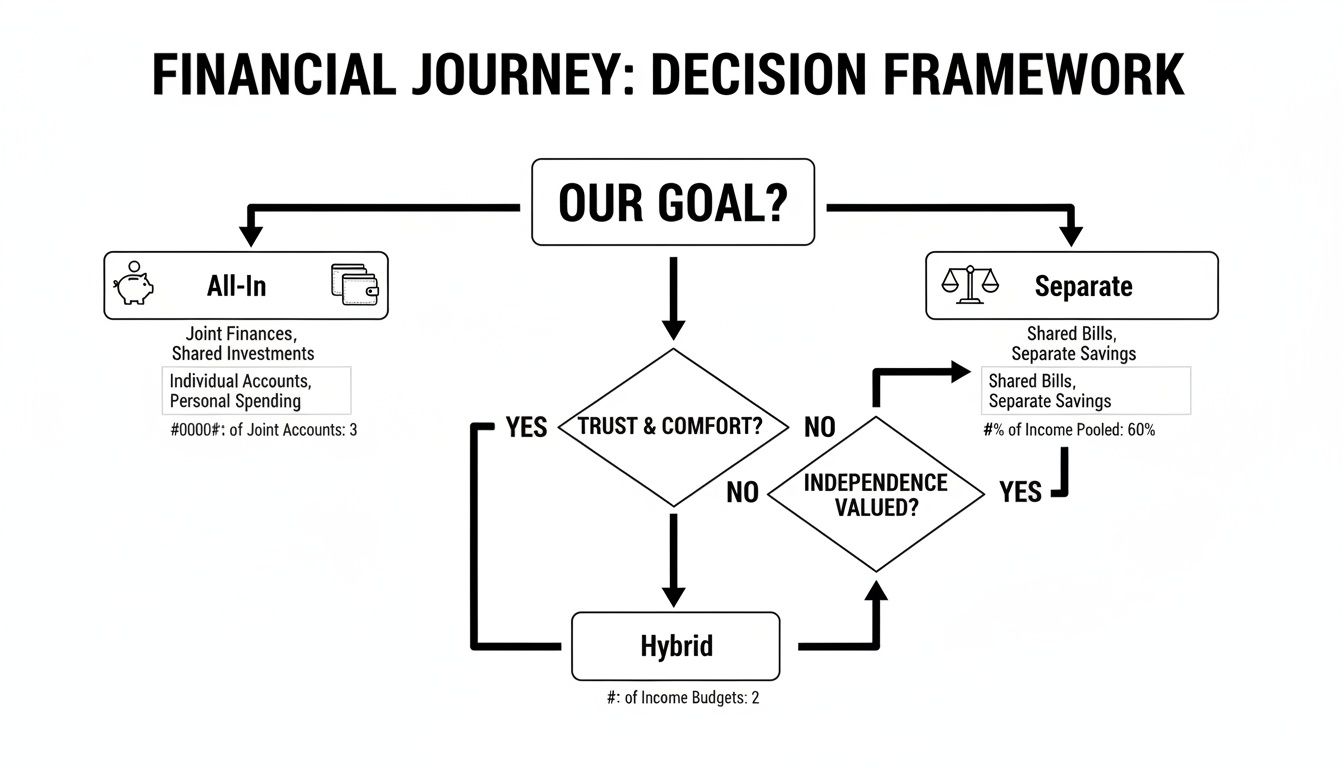
As the flowchart shows, your core goal—whether it’s total unity, complete independence, or a balance of the two—is the biggest clue to finding the right financial strategy for your marriage. This isn’t just about moving money around; it’s about building a system that strengthens your relationship for the long haul.
Comparing Financial Combination Strategies
To make the decision even clearer, here’s a quick side-by-side look at the pros and cons of each approach. Think about your unique situation, especially if you’re currently long-distance.
| Strategy | Best For | Pros | Cons |
|---|---|---|---|
| All-In | Couples seeking complete financial transparency and unified goal-setting. | Simplifies bill-paying and budgeting. Fosters a strong sense of teamwork (“our money”). | Potential loss of individual autonomy. Can be logistically complex for international couples. |
| Separate | Financially independent individuals or couples living in different countries. | Maintains full financial autonomy. Simplifies cross-border finances. Reduces conflict over small purchases. | Can create financial secrecy. Requires constant coordination for shared goals. May feel less like a team. |
| Hybrid | Couples wanting both shared responsibility and personal financial freedom. | Balances teamwork and independence. Minimizes arguments over discretionary spending. Flexible for long-distance. | Requires setting up and managing three accounts instead of one or two. Needs clear contribution rules. |
Ultimately, there’s no single “right” answer. The best strategy is the one that you and your partner can agree on and that makes you both feel secure, respected, and united as you move forward.
Creating Your Joint Financial Action Plan
Okay, you’ve picked your core financial strategy. Now it’s time to put that plan into action. This is where the conversations about joint, separate, or hybrid accounts stop being theoretical and start becoming a real, tangible part of your daily life. Taking these next steps is how you truly begin building your financial future together, especially after getting married online, where clear, deliberate actions create the strongest foundation.
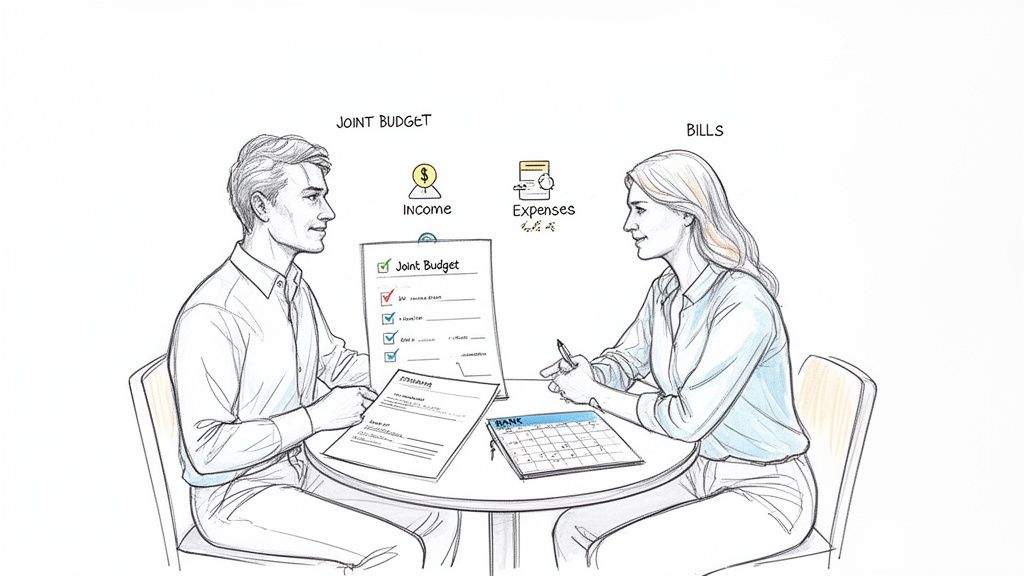
The first move is having the ‘money talk.’ And no, this isn’t just about who pays the Netflix bill. It’s a full, honest-to-goodness deep dive into your entire financial picture. Laying all the cards on the table—debts, assets, habits, fears—is the bedrock of trust that will support every single financial decision you make from here on out.
Opening Your Joint Accounts
If you landed on an “All-In” or “Hybrid” model, your first logistical task is opening a joint bank account. For couples who got married online, this is often a smooth, digital-first process, but you’ll want to have your documents ready.
Start by shopping around. Look for banks with robust online platforms, low (or no) fees, and good options for international transfers if that’s part of your plan.
To get the account open, you’ll generally need:
- Government-Issued IDs: A driver’s license or passport for both of you. If one partner is a non-resident, be prepared for additional verification steps.
- Social Security Numbers: This is standard for any U.S. bank account.
- Proof of Address: A recent utility bill or your lease agreement usually does the trick.
- Marriage Certificate: Some banks might ask for a copy to establish your relationship, so have your digital or physical certificate handy. This is a key document from your online marriage.
Once the account is live, the next step is getting the money flowing in. Figure out your direct deposit situation—are both paychecks going into this account (“All-In”), or are you each contributing a set amount or percentage (“Hybrid”)?
Setting up automatic transfers into your new joint account is a game-changer. It puts your financial plan on autopilot, removing the monthly manual effort and ensuring you’re always consistent.
Crafting Your First Joint Budget
With your accounts set up, you can build your first household budget. Think of this less as a restriction and more as a roadmap for your money. A good budget is empowering; it shows you exactly where your money is going and helps you direct it toward the things you both actually care about.
A great way to start is by tracking your spending for one full month to get an accurate baseline. Use a shared spreadsheet or a budgeting app like Mint or YNAB to see what you’re really spending on everything from rent and utilities to takeout and subscriptions.
Next, sort those expenses into buckets. Your categories might look something like this:
- Fixed Costs: Mortgage/rent, car payments, insurance premiums.
- Variable Spending: Groceries, gas, utilities, entertainment.
- Shared Goals: Visa fees, relocation fund, emergency fund.
- Debt Repayment: Student loans, credit cards, personal loans.
This process shines a bright light on your combined spending habits. It helps you spot where your habits and goals align—and where they don’t. This is how abstract financial hopes become a concrete, actionable plan for combining your finances after marriage.
Addressing Pre-existing Debt Together
Tackling pre-existing debt is easily one of the most sensitive parts of merging finances. Whether it’s student loans from one partner or credit card balances from both, that debt is now a shared problem to solve. Trying to hide or ignore it is a recipe for serious relationship stress, so you have to address it head-on.
First, make a master list of every single debt. Include the total balance, the interest rate (APR), and the minimum monthly payment for each one. This gives you a complete, no-surprises picture of what you owe.
From there, you can pick a repayment strategy. Two of the most popular methods are:
- The Debt Snowball: You focus on paying off the smallest debt first, no matter the interest rate. This approach is all about psychology—scoring quick wins builds momentum and keeps you motivated.
- The Debt Avalanche: You prioritize paying off the debt with the highest interest rate first. This method is pure math; it will save you the most money on interest over the long haul.
Choosing a strategy isn’t just about crunching the numbers; it’s about what will work for you as a couple. The key is to agree on a plan and attack it together. When you present a unified front, a potential source of conflict becomes a powerful opportunity for teamwork, strengthening your financial partnership right from the start.
Getting Real About Debt and Building a Financial Safety Net
Merging your financial lives is about so much more than just splitting the electric bill. It’s really about building a partnership that can handle whatever life throws your way. And when it comes to financial strength, two things stand out: tackling debt as a team and creating a rock-solid emergency fund.
This isn’t just about how much you earn; it’s about being smart and proactive. A solid plan for your debt and savings acts as a buffer against life’s curveballs, which is one of the most important things you can do for your marriage—especially if you started your journey with an online marriage.
Confronting Debt as a United Front
Student loans, credit card balances, a car payment… let’s be honest, most of us come into a marriage with some kind of debt. How you decide to handle it is a huge test of your financial teamwork and a defining moment in how you combine finances after marriage. Just ignoring it or, even worse, blaming each other will only lead to stress down the road.
The trick is to create a single, unified strategy. Get everything out in the open—every single debt, its balance, the minimum payment, and the most critical piece of information: the interest rate (APR). Once you have that clear picture, you can decide how you want to attack it.
There are a couple of popular ways to do this, and both are incredibly effective:
- The Debt Snowball: With this method, you hammer away at the smallest debt first, no matter what the interest rate is. As soon as it’s paid off, you take that entire payment amount and roll it onto the next-smallest debt. It’s all about momentum. Those quick wins are incredibly motivating and keep you in the game.
- The Debt Avalanche: This approach is purely mathematical. You focus all your extra cash on the debt with the highest interest rate. It might feel like it takes longer to knock out that first loan, but this method will save you the most money in interest over the long haul.
Look, neither one is “better” than the other. The right choice is the one you both can get behind and stick to. When you make that shared commitment, you turn something that could have been a source of conflict into a powerful goal you can achieve together.
Building Your Financial Safety Net
Life is messy and unpredictable. A sudden layoff, a surprise medical bill, or an unexpected visa delay can pop up out of nowhere. An emergency fund is your financial shield against these moments, keeping a temporary setback from spiraling into a full-blown crisis.
The general rule of thumb is to save 3-6 months’ worth of essential living expenses. This isn’t your “fun money” budget; this is the bare-bones cost of your mortgage or rent, utilities, groceries, gas, and insurance—everything you absolutely have to have to keep the lights on.
Your emergency fund isn’t an investment; it’s insurance. Its job isn’t to grow into a fortune, but to be there—liquid and easy to access—the second you need it.
Getting started can feel like a huge mountain to climb, but you don’t need to have six months of cash saved by next Tuesday. Just start. The most important thing is to begin automating a small, manageable amount—even $25 or $50 per paycheck—into a separate high-yield savings account. Consistency is what really matters here. Over time, those little contributions will grow into a serious financial cushion.
The current economic climate definitely puts pressure on couples. A 2023 survey revealed that 85% of Americans worry that rising wedding expenses will hurt their financial future, and a staggering 53% consider taking on debt just to pay for the big day. This just makes building that safety net even more critical as you start your married life. You can check out the full report on wedding loan trends to see how these costs are impacting other couples.
This safety net gives you something invaluable: breathing room. It lets you make clear-headed decisions from a place of stability, not panic. It’s honestly one of the greatest financial gifts you can give your marriage.
Long-Term Financial Planning for Your Future Together
Getting your daily budget and emergency fund sorted is huge. But honestly, the really exciting part of joining your finances is looking way, way down the road. This is where you shift from just paying bills to actually building the life you’ve both been dreaming about—whether that’s 10, 20, or even 50 years from now.

For couples who started their journey with an online marriage, this kind of planning feels especially powerful. It makes your partnership tangible, turning abstract hopes into a real, collaborative project you can both work on. This is the moment you stop being two people who share a bank account and start becoming a true financial team.
Aligning on Your Big Picture Goals
Before you can make a plan, you have to dream a little. What are the major milestones you really want to hit together? The first step is just having an open, exciting chat about the big stuff.
What might these long-term goals look like?
- Closing the Distance: What is your timeline for living in the same city or country? What are the associated costs for immigration and relocation?
- Buying a Home: Where do you see yourselves living? What’s the timeline? What kind of lifestyle does that home support?
- Saving for Retirement: What does “retired” even mean to you both? Is it traveling the world, picking up new hobbies, or maybe even starting a little business together?
- Planning for a Family: If kids are on the horizon, it’s never too early to start thinking about the costs of education, childcare, and everything else that comes with it.
Look, these conversations aren’t about carving a plan into stone. Life changes, and your goals will, too. The real point is just to start talking, get on the same page, and make sure you’re both pulling in the same direction.
Key Long-Term Financial Tasks
Once you have that shared vision, it’s time to roll up your sleeves and tackle the admin work that actually protects that future. These are the practical steps that legally and financially cement your partnership.
1. Update Your Beneficiaries This one is so critical but easily forgotten. Go through every single one of your accounts and policies and make sure your spouse is listed as the primary beneficiary.
- Retirement Accounts (401(k)s, IRAs)
- Life Insurance Policies
- Investment and Brokerage Accounts
2. Coordinate Retirement Savings You’re a team now, so you can be strategic. Take a look at both of your workplace retirement plans (like a 401(k)) and double-check that you’re getting the full employer match. Seriously, it’s free money—don’t leave it on the table. Then, you can decide on a combined savings goal, like aiming to save a certain percentage of your total household income.
3. Discuss Estate Planning Nobody loves talking about this stuff, but getting your estate plan in order is one of the most loving things you can do for each other. It means putting basic documents in place so your wishes are followed and your partner is protected if the unexpected happens. We’re talking about wills and assigning financial and healthcare powers of attorney.
For couples who got married online, especially with ties to different countries, these legal details are extra important. The planning can get more complex for international couples, like when one partner is navigating an online marriage for a spouse visa, which just adds another layer to consider.
The State of Our Finances Meeting
A financial plan isn’t a “set it and forget it” kind of deal. To stay on track and adapt to whatever life throws at you, you need regular check-ins. My favorite way to do this? The “State of Our Finances” meeting.
This meeting transforms financial management from a chore into a collaborative ritual. It’s dedicated time to connect on your progress, celebrate wins, and make adjustments together, reinforcing your partnership.
Try to schedule this quarterly or twice a year. Make it fun! Hop on a video call, pour a glass of wine, and turn it into a positive experience.
Here’s a simple agenda to get you started:
- Reviewing Progress: How are you tracking toward those big goals (relocation, house down payment)?
- Adjusting the Budget: Has anything changed with your income or expenses? Does the budget need a few tweaks?
- Celebrating Milestones: Did you finally pay off a credit card or hit a big savings target? Take a minute to celebrate the win!
- Revisiting Goals: Do those long-term goals still feel right? Or is it time to dream up some new ones?
This regular check-in makes sure that managing your money is a living, breathing part of your relationship—one that grows and evolves right along with you.
Common Questions About Merging Finances
Even the most airtight financial plan is going to have a few gray areas. Combining your lives after getting married online is a massive step, and it’s totally normal to have nagging questions about your unique situation. Let’s walk through some of the most common hurdles couples run into when they’re figuring out how to blend their finances.
How Should We Handle a Big Income Difference?
It’s way more common than you think for one partner to earn significantly more than the other, and it can be a tricky subject to breach. The real secret is to stop thinking in terms of “your money” and “my money” and start embracing the idea of “our money.”
Many couples find that a proportional contribution system feels the most fair. Instead of a rigid 50/50 split on everything, each person contributes a percentage of their income toward shared household expenses.
- For example: Let’s say Partner A earns $70,000 and Partner B brings in $30,000, for a combined $100,000. In this setup, Partner A would cover 70% of the shared bills, while Partner B covers 30%.
This approach ensures both partners contribute equitably based on their earning power. It prevents the lower-earning partner from feeling constantly squeezed and acknowledges that all contributions to the household—financial or otherwise—have value.
What Happens If One of Us Has Bad Credit?
A low credit score can feel like a huge roadblock, but it doesn’t have to derail your plans. Your credit reports and scores remain separate even after you get married. The catch is that one partner’s low score can definitely impact your ability to get approved for joint debt, like a mortgage or a car loan, and it will almost certainly affect the interest rates you’re offered.
Here’s how to tackle it as a team:
- Hold Off on Joint Debt: For now, the partner with the stronger credit should apply for any new loans on their own. This is especially true for international couples, as a foreign partner may not have a U.S. credit history at all.
- Create a Credit-Building Game Plan: Work together to get that lower score up. This might mean strategically paying down high-interest credit cards, setting up automatic payments to ensure they’re always on time, and checking the credit report for any errors you can dispute.
- Think About Becoming an Authorized User: The partner with great credit could add the other as an authorized user on one of their cards. As long as the account stays in good standing, this can give their score a nice boost. This move requires a ton of trust, though, since the primary cardholder is legally on the hook for the entire balance.
Tackling a low credit score together isn’t about pointing fingers. It’s about treating it as a shared financial goal, just like saving for a down payment. When you work on it as a team, you build up both your finances and your partnership.
Do We Need a Prenup if We Combine Accounts?
Prenuptial agreements aren’t just for billionaires anymore. A “prenup” is simply a legal document that lays out how your assets and debts would be handled in the unfortunate event of a divorce. While it can feel a bit awkward to discuss, many couples now see it as a smart tool for promoting honest communication and financial clarity from day one.
A prenup might be a good idea if:
- One or both of you are bringing significant assets (or debts) into the marriage.
- There’s a major gap between your incomes or future earning potential.
- One partner owns a business or has international assets.
- This isn’t the first marriage for one or both of you, especially if there are kids from a previous relationship.
Honestly, the process of creating a prenup forces you to have incredibly open and detailed conversations about money before you even get married. That kind of transparency can build an incredibly strong foundation for your financial life together, no matter what happens. For more answers to common legal questions, you can check out our full FAQ section.
How Do We Start When We’ve Already Spent a Lot on the Wedding?
The financial squeeze on newlyweds is no joke. According to the 2023 Global Wedding Report, American couples are spending an average of $30,000 on their weddings. That kind of expense can put a ton of pressure on a new marriage before you’ve even had a chance to set up a joint financial system.
If you’re kicking things off with wedding debt or drained savings, the absolute first step is to get on the same page and make a plan.
Your top priority should be building a small emergency fund. A starting goal of $1,000 is perfect. This gives you a tiny cushion so the first unexpected car repair doesn’t send you into a panic. Once that’s in place, you can start aggressively tackling any wedding debt using a strategy like the debt snowball or avalanche method to get your new life started on solid ground.


