


Getting your marriage certificate online is a simple, legally valid process that modern couples are choosing to complete their paperwork from home, skipping the courthouse lines and rigid office hours. This guide provides actionable steps to make your online marriage journey faster, easier, and stress-free.
Why Couples Are Choosing Online Marriage Applications
The path to getting married is deeply personal, but the administrative side often feels stuck in the past. Today, more couples are ditching the traditional courthouse visit and embracing the simplicity of applying for their marriage certificate online. This shift reflects a modern desire for efficiency and control over one of life’s biggest moments.
The reasons for this change are practical and powerful. It’s about more than just convenience; it’s about taking concrete steps to get your time and energy back.
- Actionable Flexibility: If you’re in a long-distance relationship or have a demanding job, you can apply online from separate locations without coordinating a trip to the county clerk’s office.
- Actionable Time Savings: Instead of taking a full day off work, complete the application during your lunch break. What used to require hours of travel and waiting can now be finished in minutes.
- Actionable Stress Reduction: The online process removes the anxiety of navigating government buildings and standing in lines. This keeps the experience relaxed and joyful, allowing you to focus on your marriage.
A Modern Solution for a Modern World
This digital-first approach aligns perfectly with how many relationships start and grow. The global marriage and dating software market, which hit $15 billion in 2025, is on track to reach $40 billion by 2033. This boom is driven by couples who meet online and naturally expect the process of making their union legal to be just as smooth.
Your Action Step: Choose an online marriage certificate application to free yourself from administrative headaches so you can focus on what truly matters—celebrating your commitment.
This modern approach isn’t just a trend; it’s a practical solution that offers a faster, more accessible path to getting legally married. To understand the full process, review our guide on virtual weddings to see how it works in practice.
Where Can You Actually Apply for a Marriage Certificate Online?
Before you plan a virtual ceremony, your first step is to answer a critical question: where is an online marriage application legally recognized? The convenience of getting married from your living room isn’t available everywhere. In fact, a ‘digital marriage divide’ exists across the United States.
Some states have fully embraced remote processes, while others still require you to show up in person for at least one step. Knowing this from the start will save you from major headaches. A true end-to-end online marriage means you handle everything—uploading documents, video verification, the ceremony, and receiving your legal certificate—without ever leaving home.
The Digital Marriage Divide
The gap between states offering modern, digital marriage services and those using old-school, in-person methods is surprisingly wide. This isn’t just about downloading a PDF; it’s about a complete, legally binding virtual process from start to finish.
A recent report from the Information Technology and Innovation Foundation (ITIF) highlighted this issue, finding that only 10 out of 50 states offer top-tier, fully online services for obtaining a marriage license. These pioneers include places like Utah and New York. On the flip side, some major counties in states like Georgia and Pennsylvania offer zero online options. You can review the complete findings in the state-by-state digital marriage report on ITIF.org.
This divide is why choosing the right jurisdiction is your most important first action. It determines whether your path to “I do” is a smooth digital highway or a bureaucratic maze.
To help you decide, here’s a breakdown of what these differences mean for you.
Online Marriage Application Availability Across US States
| Service Level | Example States | Your Action Plan |
|---|---|---|
| Fully Digital | Utah, New York, Arizona | Choose this option for maximum flexibility. Complete the entire process—application, ID verification, ceremony, and certificate issuance—from anywhere with an internet connection. |
| Partially Digital | California, Florida | Be prepared for an in-person visit. You can start the application online but will likely need to go to the clerk’s office to show ID or pick up the license. |
| No Online Option | Georgia (some counties), Pennsylvania (some counties) | Plan for a courthouse trip. Both partners must physically go to the courthouse to apply for and receive their marriage license. |
As you can see, where you “get married” online has a huge impact on your experience. For couples seeking maximum convenience, especially if they live in different places, a fully digital state is the best choice.
What a True End-to-End Experience Looks Like
So, what should you expect when a state offers a fully remote process? Your online marriage journey will involve a few key stages, all handled from your computer or phone.
- Online Application Portal: Start on a secure website where you will create an account and fill out the necessary forms.
- Digital Document Uploads: Scan or take clear photos of your IDs and any other required paperwork and upload them directly.
- Virtual Verification: Join a short video call with a clerk or officiant to confirm your identity and consent to the marriage.
- Remote Ceremony: The legal ceremony happens over a live video stream with an authorized officiant.
- Digital Certificate Issuance: Immediately after the ceremony, you will receive a digital copy of your marriage certificate, followed by the certified hard copies in the mail.
Actionable Example: A couple living in Texas can legally get married online through a service authorized by Utah County. They complete the entire process remotely—application, video call, and ceremony—and receive a Utah-issued marriage certificate that is legally recognized nationwide.
This is the gold standard for online marriage. To learn more about where this is possible, check out our guide on US states that allow online marriage. Knowing which states offer these seamless services is the key to a straightforward path to your legal union.
Getting Your Paperwork Ready for a Smooth Application
The secret to a successful online marriage certificate application is preparation. Having all your documents sorted out before you start filling out forms is the single best action you can take to avoid frustrating delays.
It’s not just about having the right papers; it’s about making sure each one is ready for digital submission. Think of it like packing for a trip: a little effort upfront saves a huge headache later.
The Essential Document Checklist
While requirements can vary, nearly every online portal asks for the same core documents. Your job is to prepare high-quality digital versions of these items.
- Valid Government-Issued Photo ID: This is non-negotiable. Use a driver’s license, state ID card, or passport. The key here is “valid” and “unexpired.” An ID that expired last week will be rejected.
- Proof of Age (If Needed): Your ID usually covers this, but some jurisdictions might ask for a birth certificate, especially for younger applicants.
- Proof of a Previous Marriage Ending: If either of you has been married before, you must provide a certified copy of the final divorce decree, annulment papers, or the death certificate of the former spouse. This proves you are legally able to remarry.
Before you start, check that the names on your application exactly match your legal documents. A forgotten middle initial or using a nickname can halt the process. For a detailed breakdown, our guide on what you need for a marriage license is a fantastic resource.
Creating Perfect Digital Copies
How you scan or photograph your documents is as crucial as having the right ones. A blurry image is the same as no submission at all. You can use your smartphone if you follow these simple steps.
- Find Good, Flat Lighting: Lay your document on a flat surface in a well-lit room. Avoid shadows or glare. Natural light from a window is best.
- Capture the Whole Document: Ensure all four corners are visible in the picture. Do not crop the edges, as this can invalidate the image.
- Perform a Clarity Check: Zoom in on the picture. Can you read every word and date clearly? If it looks even slightly fuzzy, retake it.
Actionable Tip: A common mistake is taking a picture of an ID from an angle. Hold your phone directly above the document to avoid distortion and ensure sharp focus. This one adjustment can be the difference between approval and rejection.
Taking five extra minutes to create clear digital copies ensures your application moves smoothly through verification. This prep work puts you in control, letting you focus on the more exciting parts of getting married.
Navigating the Online Application Process
With your documents scanned and ready, it’s time for the main event: the online application. This is where everything comes together, but it’s also where a tiny mistake can create a massive headache. Let’s walk through each phase so you can get it done right the first time.
The process involves creating an account, entering your details, uploading documents, and completing a quick verification. The image below shows the core documents you’ll need.
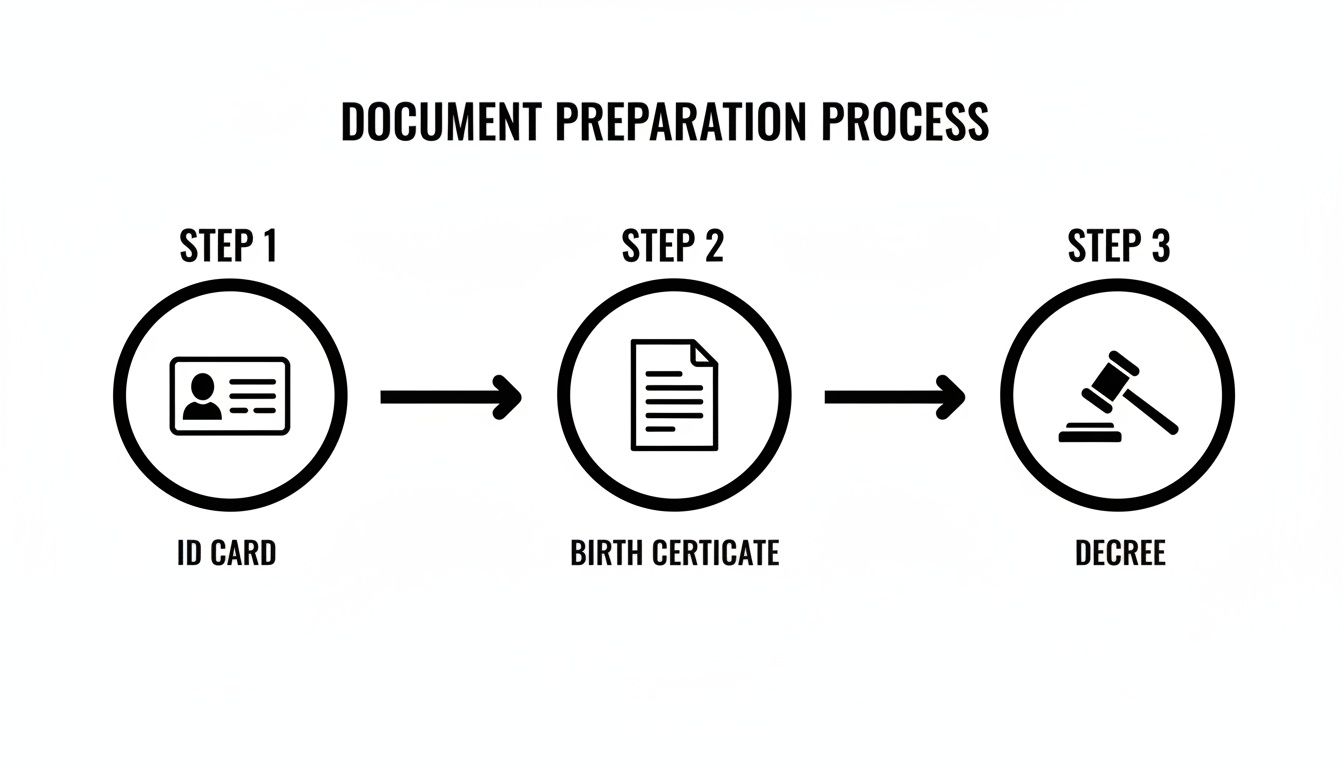
Think of these—your ID, proof of age, and any previous marriage dissolution papers—as the foundation of your entire application.
Securing Your Account and Personal Details
First, you’ll need to create a secure account and fill in your personal information. This part seems simple, but it demands precision. Treat this step with the same attention to detail as a passport application.
The most common mistake is using nicknames or shortened names. You must enter your full legal name exactly as it appears on your government-issued ID. A seemingly harmless error, like typing “Jen” instead of “Jennifer,” could flag your application for manual review and halt the process.
- Actionable Step: Proofread Everything. Before you click “next,” carefully review every field. Is your date of birth correct? Your parents’ full names? Your place of birth?
- Actionable Step: Use a Real Email. Sign up with an email you check daily. This is where you’ll receive all official updates, including the link for your virtual verification call.
Getting this initial data entry perfect prevents significant trouble later.
Uploading Your Documents with Confidence
Once your details are in, you’ll reach the document upload portal. This is where your prep work pays off. The system will prompt you to upload the digital copies of your ID, birth certificate, and any other required documents.
Pay close attention. Make sure you upload the correct file into the correct slot. Most portals accept only PDF, JPG, or PNG file types.
Actionable Tip: Name your files clearly before you begin. For example, “John_Doe_Drivers_License.jpg” is much better than “IMG_5042.jpg.” This simple habit makes it nearly impossible to upload the wrong document.
Most systems provide a preview after you upload. Use this final check to confirm the image is crystal clear and nothing is cut off.
Preparing for the Virtual Verification Call
The final piece of the puzzle is usually a brief video call with a clerk to confirm your identity and intent to marry. It’s a low-stress formality, and a little prep makes it go smoothly.
Follow these simple steps for a successful call:
- Do a Tech Check: A day or two before the call, test your camera, microphone, and internet connection to avoid technical glitches.
- Find a Good Spot: Choose a quiet, well-lit room where you won’t be interrupted. The official needs to see your faces clearly to match them to your photo IDs.
- Keep Your Docs Nearby: Have your physical, original IDs and other documents with you. The clerk will likely ask you to hold them up to the camera.
Treat it like any other important meeting. Be on time and prepared, and you’ll be done in minutes. This quick confirmation is the final step before you’re officially approved for your marriage certificate.
So, What Happens After You Hit “Submit”?
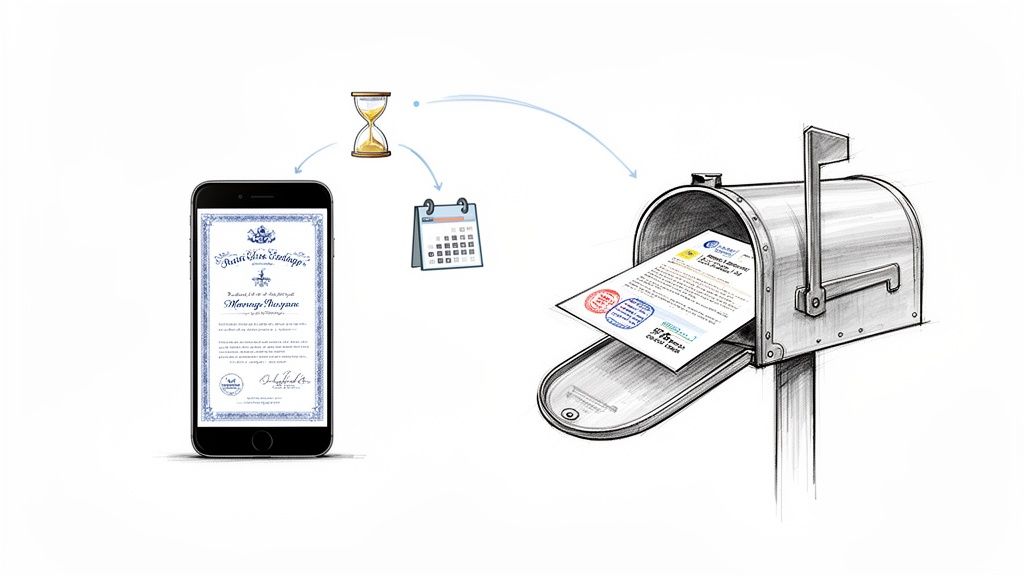
The moment you click “submit” is a huge relief, but it’s normal to wonder what comes next. This is where the digital approach shines, trimming weeks of waiting into just a few days.
Once submitted, your application is reviewed by a county clerk who matches your uploaded documents to the information you entered. This is why using clear scans and your full legal name is so critical.
If any issues are found—like a blurry ID or a typo—the application will be returned to you for correction. This causes a minor, but avoidable, delay. If everything checks out, you’ll get an approval confirmation via email, often within one to three business days. That email is your green light and will include instructions for scheduling your virtual ceremony.
Digital vs. Traditional Timelines: No Contest
The speed difference between online and in-person applications is massive. A traditional process means booking an appointment, traveling, and waiting in line. If there’s a problem, you might have to return another day.
The online system handles verification behind the scenes, creating a much faster timeline.
- Online Processing: Initial review and approval can happen in as little as 24 hours. You can then book a virtual ceremony slot within a week, depending on availability.
- Traditional Processing: The entire process, from getting an appointment to receiving the license, can easily take several weeks.
Your Takeaway: Applying online dramatically shrinks the administrative timeline. What used to be a multi-week headache can now be completed from start to finish in less time than it takes to plan a long weekend.
From Digital Confirmation to Certified Hard Copy
After your virtual ceremony, you are legally married. Congratulations! You’ll likely receive a digital copy of your marriage certificate almost immediately. However, it’s the certified hard copy that is required for all official purposes.
This document, bearing the official seal from the issuing authority, is essential for post-wedding administrative tasks. The issuing office typically mails this certified copy to you within 5 to 10 business days after your ceremony. You must have it for:
- Updating your name on your Social Security card and driver’s license.
- Changing your name on bank accounts, credit cards, and your passport.
- Adding your spouse to your health insurance plan.
Attempting these legal and financial updates without the certified paper document is nearly impossible. Actionable Tip: Order several extra certified copies when you can. It will save you significant time and hassle down the road.
The Future of Digital Marriage Legislation
The legal world is finally catching up to how modern couples live, making marriage more accessible for everyone.
The temporary rules allowing virtual ceremonies during the pandemic kickstarted a movement that is now evolving into permanent law. This isn’t just a minor update; it’s a fundamental change in how the government handles one of life’s biggest milestones.
This push is happening because people are demanding it. For long-distance couples or those with mobility issues, an in-person process is a significant barrier. Lawmakers are starting to understand that an online marriage certificate application isn’t a luxury—it’s a necessary service.
New Laws Are Making Virtual Weddings the Norm
Momentum is building across the country as several states introduce bills to permanently allow couples to apply for licenses and hold ceremonies via video conference. This is fantastic news for couples everywhere.
What was once a niche option is quickly becoming a mainstream, legally sound path to marriage.
Major legislative efforts in Illinois, New Hampshire, and New Jersey could soon enable fully remote marriage options. If passed, these could expand digital access to 20 million more Americans. One bill in Illinois is specifically designed to help disabled couples by allowing virtual meetings with the clerk. You can get a closer look at how these upcoming marriage laws are changing the legal landscape.
What This Means for Your Online Marriage
This wave of new laws provides legal certainty and opens up a world of possibilities for your wedding.
- Greater Accessibility: These laws remove geographical and physical barriers, making legal marriage available to more people than ever.
- Increased Legal Recognition: As more states codify these rules, the legal standing of online marriages becomes rock-solid and universally accepted.
- More Options for You: You will have more choices in how and where you get legally married, empowering you to design a ceremony that truly reflects your relationship.
Your Takeaway: The legal foundation for online marriage is growing stronger every day. This is not a temporary fad but the future of how legal unions will be formed, reflecting a modern world that values efficiency, accessibility, and personal choice.
Answering Your Top Questions About Online Marriage Certificates
Even with all the benefits, it’s normal to have questions when considering an online marriage certificate application. Here are answers to the most common ones to help you move forward with confidence.
Is an Online Marriage Certificate Actually Legally Valid?
Yes, absolutely. When your application is processed through a legally recognized jurisdiction, such as Utah County, the marriage certificate you receive is 100% legally binding.
It holds the same legal weight as a certificate obtained in person at a courthouse. This document is recognized in all 50 U.S. states and around the world, though some countries may require an additional validation step called an apostille.
How Long Does the Whole Online Process Take?
While the exact timeline can vary, getting married online is significantly faster than the traditional route. Most couples can complete the application itself in under an hour.
From there, you can often book a virtual ceremony with an officiant within a few days. After your ceremony, you will typically receive a digital copy of your marriage certificate immediately, with the official certified hard copies arriving by mail within one to two weeks.
Actionable Advice: The most common delays come from simple, avoidable mistakes. Using a nickname instead of your full legal name, uploading a blurry or expired ID, or a typo in your date of birth can halt the process. Always double-check every field before you submit.
Can We Be in Different Places for the Ceremony?
Yes, you can. This is one of the biggest advantages of getting married online.
Jurisdictions that specialize in virtual weddings, like Utah, allow couples to be in different cities—or even different countries—during the ceremony. The only requirement is that both of you are present on the video call together to say your vows. For long-distance couples, this is a game-changer that makes your union official without the cost and hassle of travel.
Ready to start your own journey? Here at Marryfromhome.com, we make getting legally married online simple, fast, and completely stress-free. You can learn more and start your application today at https://marryforhome.com.


