


Getting married over a video call might sound like something out of a sci-fi movie, but it’s a fully legal and binding ceremony that’s helping couples all over the world tie the knot. This isn’t just a pandemic-era trend; it’s a real solution that tears down geographical barriers, making it an incredibly practical option for international and long-distance couples.
Your Guide to a Modern ‘I Do’
Distance or travel hassles shouldn’t stand in the way of saying “I do.” With the rise of virtual marriage, there’s now a clear, simple path to a legal union for countless couples who thought it might be impossible. This guide is your complete roadmap, designed to walk you through every single step with total clarity and confidence.
We’ll cover all the essentials, from figuring out if you’re eligible to that amazing moment you get your official marriage certificate in the mail. Think of this as your personal checklist for getting hitched online.
What We Will Cover
We’ve broken the entire journey down into easy-to-digest pieces so you feel prepared, not overwhelmed. You’ll learn all about:
- Verifying Eligibility: How to confirm that you and your partner tick all the necessary legal boxes.
- Gathering Documents: A rundown of the exact ID and paperwork you’ll need for a hassle-free process.
- The Virtual Ceremony: What actually happens during the live video call with your officiant.
- Making It Official: The process of getting your marriage license signed, filed, and turned into a legal certificate.
This simple visual breaks down the core of how a virtual marriage online actually works.
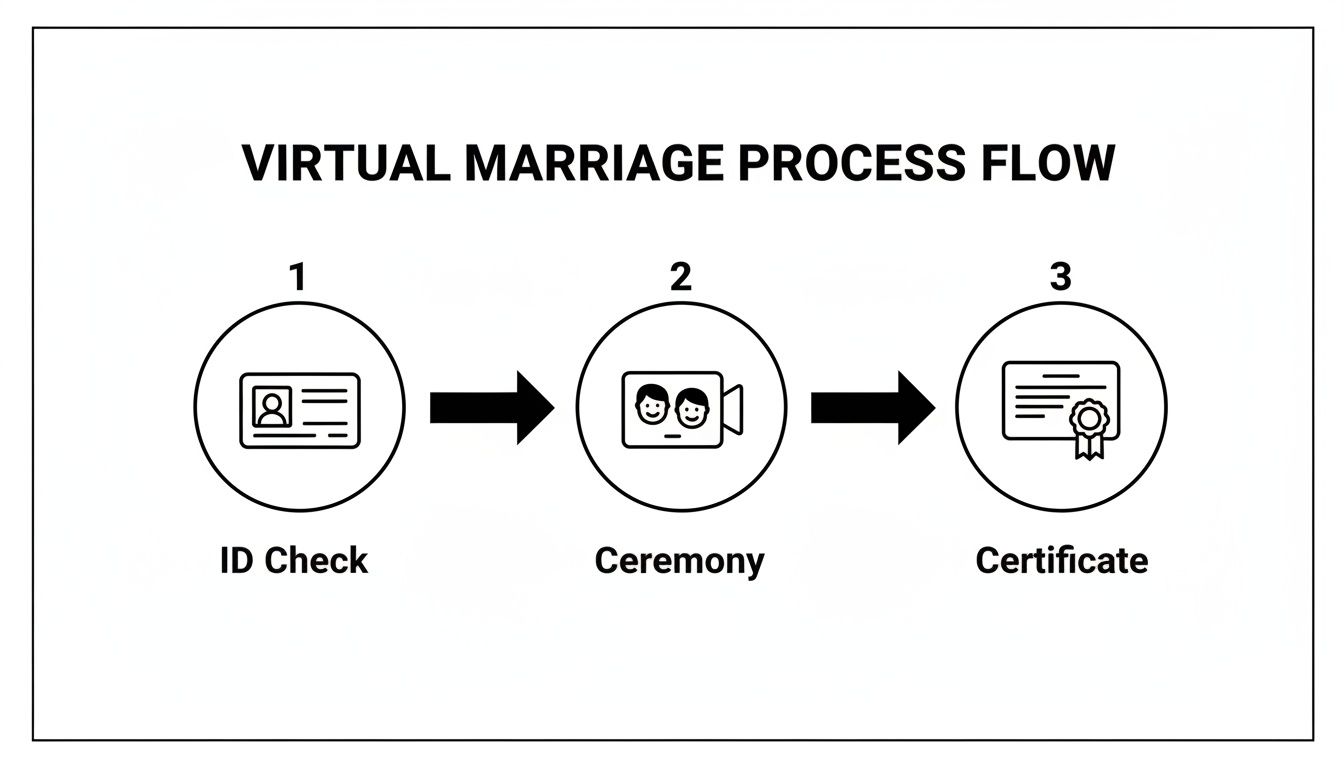
As you can see, the whole thing boils down to three key phases: verifying your identity, having the ceremony, and getting the certificate. It’s this streamlined structure that makes it so efficient.
By the time you’re done with this guide, you’ll have everything you need to know to confidently plan your own digital big day. And while the concept is modern, it’s really important to know the difference between the various types of remote weddings out there. You can get the full scoop on the differences between virtual, proxy, and web conference ceremonies in our detailed article. It’ll help you pick the exact path that’s right for your unique situation.
Understanding the Legal Side of Your Online Marriage
Before you start picking out virtual backgrounds, let’s talk about what makes an online marriage a real, legally-binding union. The entire process hinges on a specific legal framework in the U.S.: licensed officiants in certain states can legally marry couples who are located anywhere on the planet.
A lot of couples get tripped up on the idea of jurisdiction. They wonder, “If we’re in two different countries, where are we actually getting married?” The answer is simple. The legality of your marriage has nothing to do with where you and your partner are sitting during the ceremony.
It’s all tied to the U.S. state and county where your officiant is based and where your marriage license is officially filed. You could be in Tokyo and your partner in London, but your marriage is legally registered in a place like Utah. This is the magic that makes online marriage a game-changer for international and long-distance couples.
How Different States Handle Online Marriage
Getting married entirely online isn’t something you can do just anywhere in the United States. There’s a pretty significant “digital marriage divide,” with only a handful of states truly embracing the concept from start to finish.
As of 2026, only a few pioneering states, like Utah, offer a completely digital marriage process. This means everything from the license application and ID verification to the ceremony and receiving a certified digital certificate can be done online. This is how platforms like MarryFromHome can operate seamlessly, offering a single, streamlined service.
Many other states, however, are still playing catch-up, requiring at least one in-person visit or a bunch of mailed paperwork. It creates a real patchwork of rules across the country.
Key Takeaway: Your marriage is legally valid because it complies with the laws of the specific U.S. jurisdiction that issues your license—not where you are in the world. This is the core principle that makes global virtual weddings possible.
This point is absolutely critical. It’s what ensures your marriage is recognized by the U.S. government, which is the first step toward getting it recognized anywhere else. For a closer look at the nuts and bolts, you might want to read our guide on how to get married online legally.
For International Couples: The Hague Apostille
If you or your partner live outside the U.S., there’s one final, crucial piece to the puzzle: the Hague Apostille. It sounds fancy and complicated, but it’s actually pretty straightforward.
An apostille is just an official certification that authenticates your U.S. marriage certificate for use in other countries. Think of it as an international notary stamp that proves your document is legit.
Here’s the action plan for getting one:
- Get Your Certificate: First, the U.S. county issues your official marriage certificate after the ceremony.
- Request an Apostille: Work with your online marriage service to request the apostille. They will handle the submission for you.
- State Verification: The certificate is then sent to the Secretary of State (or a similar office) in the state where it was issued. That office attaches the apostille, which verifies the signature and seal on your certificate.
Once you have the apostilled certificate, it serves as undeniable proof of your legal marriage. It’s the document you’ll need for immigration, residency applications, or any other official business in your home country. This final step is what bridges the gap between your U.S.-based ceremony and global recognition.
Getting Your Ducks in a Row: Documents and Tech Prep
Once you’ve confirmed you’re good to go legally, it’s time to shift gears to preparation. This part is all about gathering your documents and sorting out your tech. Getting these details handled now means you can be fully present with each other during the ceremony, instead of frantically searching for a document or dealing with a fuzzy video feed.
Think of it as the digital equivalent of a wedding rehearsal. A little bit of planning goes a long way toward a smooth, memorable “I do.”
Your Document Checklist
First up, let’s talk paperwork. The process is really just about proving who you are and that you’re legally able to marry. You’ll need to have clear, digital copies of a few things ready to go.
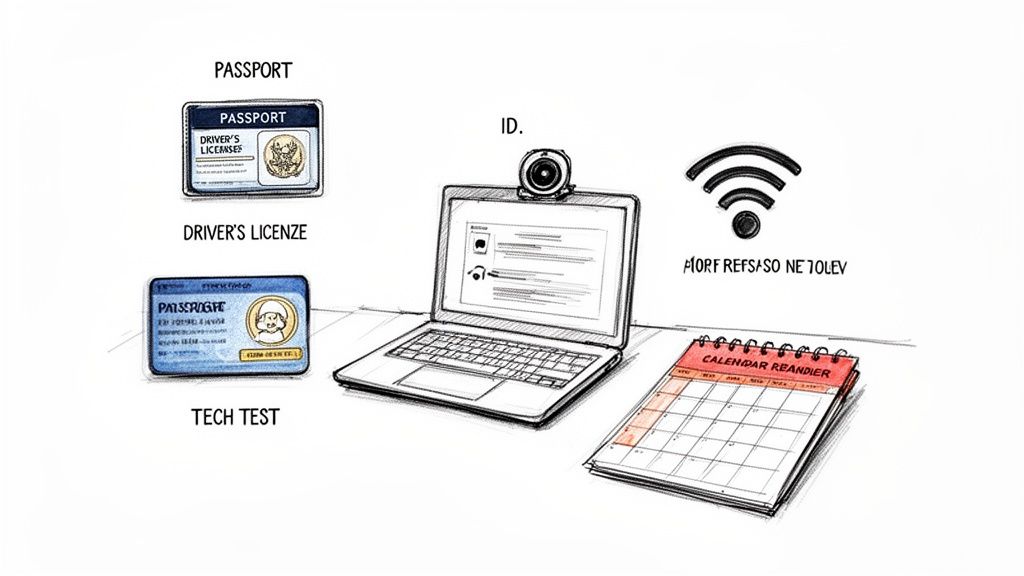
- Government-Issued Photo ID: This is non-negotiable. Both you and your partner need a valid, unexpired photo ID. A passport is the gold standard and works everywhere, but a driver’s license or other state-issued ID is usually perfectly fine.
- Proof of Previous Marriage Dissolution (If Applicable): If this isn’t your first marriage, you’ll need to show that your previous one has legally ended. This means providing a copy of the final divorce decree or a death certificate for a former spouse. It’s a standard legal step to confirm you’re free to marry again.
Your first step is to take clear photos or scans of these documents. You’ll upload them through a secure portal provided by your online marriage service to begin your application.
Setting the Stage: Your Tech Setup
You absolutely do not need to be a tech guru for this, but a solid setup is key. The goal is simple: clear video and crisp audio so everyone can see and hear you. This really just comes down to your device, your internet connection, and where you set up.
Your internet connection is the single most important piece of the puzzle. A choppy or slow connection is the top reason for frozen screens and dropped calls—the last thing you want on your wedding day. Run a speed test ahead of time. If it looks a little weak, try moving closer to your Wi-Fi router or, even better, plugging in directly with an Ethernet cable for rock-solid stability.
Pro Tip: A few days before the ceremony, do a quick test call. Ring up a friend or family member using the exact same device and from the exact spot you plan to use for the wedding. This is the best way to catch any weird audio echoes, bad lighting, or camera angle issues before they become a problem.
Lighting makes a huge difference, too. Natural light is your best friend. Try to set up facing a window so the light is on your faces. If you have your back to a window, you’ll probably look like a silhouette. No natural light? No problem. Just place a lamp or another light source in front of you, not behind you.
Finally, give your camera and microphone a quick test. The built-in ones on most modern laptops and smartphones are surprisingly good. If you want to step it up a notch, an external webcam or USB microphone can make a big impact on quality. Whatever you choose, just make sure you’ve tested it beforehand. For a deeper dive into what you might need, you can learn more about the requirements for a marriage license in our detailed article.
To make it even easier, here’s a quick checklist to run through before your ceremony.
Virtual Ceremony Tech Checklist
Use this checklist to ensure your tech setup is ready for your online ceremony.
| Tech Component | Checklist Item | Pro Tip |
|---|---|---|
| Device | Choose a laptop, tablet, or desktop computer. | A larger screen is often better than a phone for seeing the officiant and guests clearly. |
| Internet | Run a speed test (aim for 10 Mbps upload/download). | If your Wi-Fi is spotty, use a wired Ethernet connection for the most reliable signal. |
| Camera | Test your built-in or external webcam. | Clean the lens with a microfiber cloth for a crisp, clear picture. |
| Microphone | Test your built-in or external mic for clear audio. | Do a test call to check for echoes or background noise. Headphones with a mic can help. |
| Lighting | Position yourself facing a natural light source (a window). | Avoid having a bright light or window directly behind you. |
| Software | Download and test the video conferencing app (e.g., Zoom). | Make sure the app is updated to the latest version to avoid last-minute issues. |
Nailing your tech setup is one of the easiest ways to ensure your virtual ceremony feels special and runs without a hitch.
What to Expect During Your Virtual Wedding Ceremony
The moment you click “join meeting,” you might feel a few butterflies. That’s totally normal. But those nerves quickly turn into pure excitement. Getting married online isn’t some cold, robotic transaction. It’s an intimate, focused, and deeply personal event led by a real, licensed officiant who knows exactly how to make the moment feel special.
Right away, the officiant’s job is to put you at ease. They’ll start with a warm greeting, confirm your identities one last time, and then briefly walk you through how the ceremony will unfold. Their goal is to make sure you feel comfortable and present for what’s about to happen.
The Heart of the Ceremony
The core of any wedding ceremony, virtual or not, is the legal declaration. Your officiant will guide you through the required statements, often called the “declaration of intent.” This is the key moment where you both verbally state that you consent to marry each other. It’s simple, but powerful.
Once the legal bits are handled, the ceremony opens up and becomes uniquely yours. This is where the flexibility of a virtual wedding really shines. You have complete freedom to personalize the experience and share it with the people who matter most.
Here are actionable ways to personalize your ceremony:
- Invite Virtual Guests: Simply share the ceremony link. Friends and family from across the globe can log in and witness your vows live, no plane tickets required.
- Write Personal Vows: Exchange promises you’ve written yourselves to add an emotional, personal layer to the proceedings.
- Plan a Ring Exchange: You can absolutely still exchange rings! The officiant will give you a cue, creating that classic, timeless wedding moment, even over video.
- Prepare a Post-Ceremony Toast: Keep a bottle of champagne or sparkling cider handy. As soon as you’re pronounced married, you can share a celebratory toast with your new spouse and anyone watching online.
This desire for personalization isn’t just a hunch; it’s a major trend. Recent industry data shows that 61% of couples now write their own vows. It’s part of a bigger shift toward more intimate, customized events, which is a perfect fit for a virtual marriage online. Tech is playing a bigger role in general, with 36% of couples now using AI in their wedding planning—a figure that nearly doubled in just one year. You can see more of these trends in the 2026 Real Weddings Study from The Knot Worldwide.
The Official Pronouncement
After the vows and any personal touches you’ve added, the officiant delivers the final, official pronouncement. With a few powerful words, they will declare you legally married. It’s a moment of pure joy and relief, often followed by cheers from any family and friends watching from their own screens.
This is the climax of your ceremony—the exact instant your legal status changes. The officiant will say something like, “By the power vested in me by the State of [State], I now pronounce you married.”
From there, the officiant will offer their congratulations and give you a quick rundown of what happens next with your marriage license and certificate. The whole thing is incredibly efficient yet deeply meaningful, usually lasting about 15 minutes. It’s a modern, heartfelt, and legally-binding way to start your life together, proving that a memorable wedding is defined by the connection you share, not the venue you’re in.
Making It Official: Your Marriage License and Certificate
The virtual confetti has settled, you’ve been pronounced married, and the happy tears are drying. Congratulations! It’s an incredible moment, but there are still a few crucial steps to officially button everything up and make your marriage legally recognized by the government.
The good news? This part is handled almost entirely by your officiant and the online marriage service you used. You get to skip the headache of navigating confusing government websites or standing in line at a county clerk’s office.
Right after you say your “I dos,” your officiant gets to work. They’ll digitally sign your marriage license and immediately file it with the correct government authority, which is typically the county clerk in the U.S. state that issued it. This is the key action that officially records your marriage.
Receiving Your Marriage Certificate
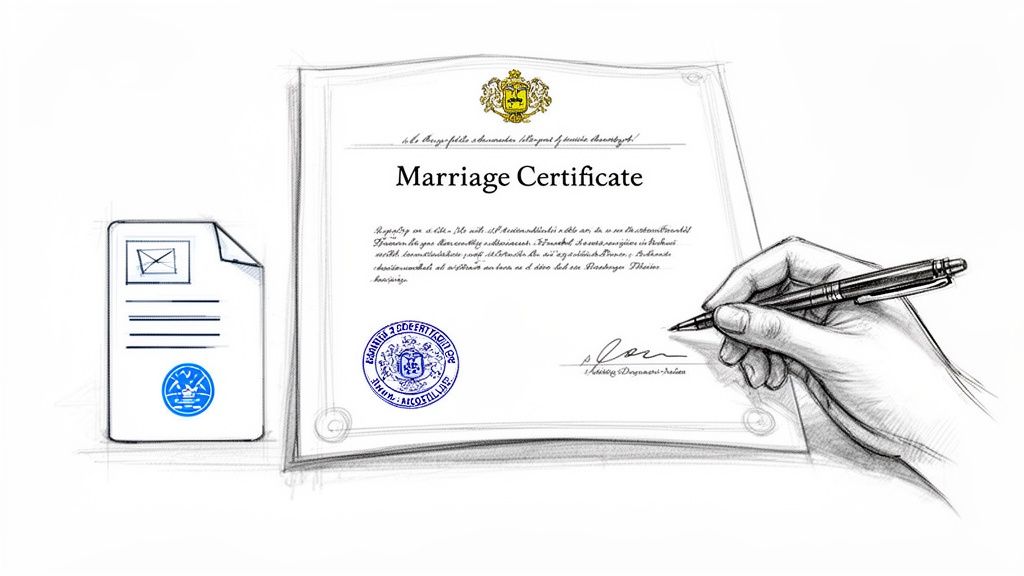
Once the county has processed that signed license, they issue your official marriage certificate. This is the legal document you’ll use to prove you’re married. Most reputable online marriage platforms have this process down to a science, sending you both digital and physical copies.
Here’s what you can generally expect for a timeline:
- Digital Certificate: You’ll often get a certified digital copy of your marriage certificate within just a few business days. This is perfect for any immediate needs you might have, as it’s accepted as official proof for many online applications.
- Physical Certificate: The official hard copy is sent via mail and usually arrives within a couple of weeks. Keep in mind that international shipping can add a bit more time.
This dual-format system is great because it gives you immediate proof of marriage while you wait for the official paper document to arrive at your door.
Your marriage certificate is so much more than a piece of paper. Think of it as the key that unlocks all the shared legal benefits and responsibilities of marriage—from immigration and insurance to joint bank accounts and property ownership. It’s the official foundation of your new life together.
The Apostille Process for Global Recognition
If you and your partner live outside the United States, there’s one final, absolutely critical step: getting an apostille. As we touched on earlier, this is a special international certification that authenticates your U.S.-issued marriage certificate so it’s recognized in your home country.
Think of it as a global seal of approval.
Your online marriage service will manage this entire process for you. They’ll send your certificate to the correct U.S. state authority to have the apostille attached. This step ensures that when you show your marriage certificate to your local government for things like visa applications or residency permits, there’s no question about its authenticity.
This final bit of paperwork provides total peace of mind, confirming your virtual ceremony resulted in a fully legal and globally recognized marriage. It bridges the gap between your online “I do” and your official status as a married couple, no matter where in the world you call home.
Got Questions About Getting Married Online?
As you get closer to taking the leap, it’s totally normal to have a few lingering questions. You want to be sure about the details, and we get it. Let’s tackle some of the most common things people ask, giving you the clear, straightforward answers you need to move forward with confidence.
The whole idea of a virtual wedding is catching on fast. In fact, the global internet wedding market is on track to hit a massive $231,324.48 million by 2033, with a 12.7% compound annual growth rate. That’s not just a niche trend; it shows that getting a virtual marriage online is becoming a go-to option for couples everywhere, especially those bridging long distances. You can see the full breakdown of these market growth trends at Data Insights Market.
Is a Virtual Marriage Legally Recognized Everywhere?
Yes, a marriage performed online through a U.S.-based service is 100% legal and binding. The key is that your marriage’s validity is tied to the U.S. state where it’s officiated and recorded—not where you are physically located during the call.
For international couples, you’ll likely need a document called an Apostille. Think of it as an extra layer of official authentication that makes your U.S. marriage certificate valid in your home country for things like immigration, residency, or other legal matters. We can absolutely help you get one.
Can We Get Married Online from Different Countries?
Definitely. This is one of the biggest reasons couples choose to get married online. As long as you both meet the age and ID requirements and have a decent internet connection, you can be in completely different parts of the world.
We’ve officiated ceremonies for couples on separate continents. The officiant simply joins you both on a video call to legally conduct the wedding, making geography irrelevant.
Key Insight: Your physical location doesn’t matter for the legality of the marriage. The entire process is legally anchored in the U.S. jurisdiction of the officiant and the county that issues your marriage license.
What If We Have Tech Problems During the Ceremony?
Don’t sweat it—we’ve got backup plans for technical hiccups. We always push for a quick pre-ceremony tech check to catch and solve most potential issues ahead of time. Honestly, this simple step prevents almost all common glitches.
If someone’s connection drops during the ceremony, the officiant will just pause and wait patiently for you to hop back on. Our support team is also on standby to help troubleshoot anything unexpected, so a minor glitch won’t derail your big moment.
How Long Does the Entire Process Take?
The speed of a virtual marriage online is a huge plus. From the moment you submit your application to receiving your digital marriage certificate, the whole thing can often be wrapped up in just a few days.
The live virtual ceremony itself is designed to be short but sweet, typically lasting about 15 minutes. It’s the perfect blend of official proceedings and personal connection, letting you become legally married without the months of planning that come with a traditional wedding.


