


Yes, you can get legally married online. This isn’t just a symbolic ceremony—it’s a process that provides a fully binding legal marriage certificate. It works by securing a valid marriage license remotely and having a certified officiant perform the ceremony over a video conference. The resulting marriage is legitimate and recognized across the U.S. and in most countries worldwide.
Your Path to Matrimony: How to Get Married Online Legally
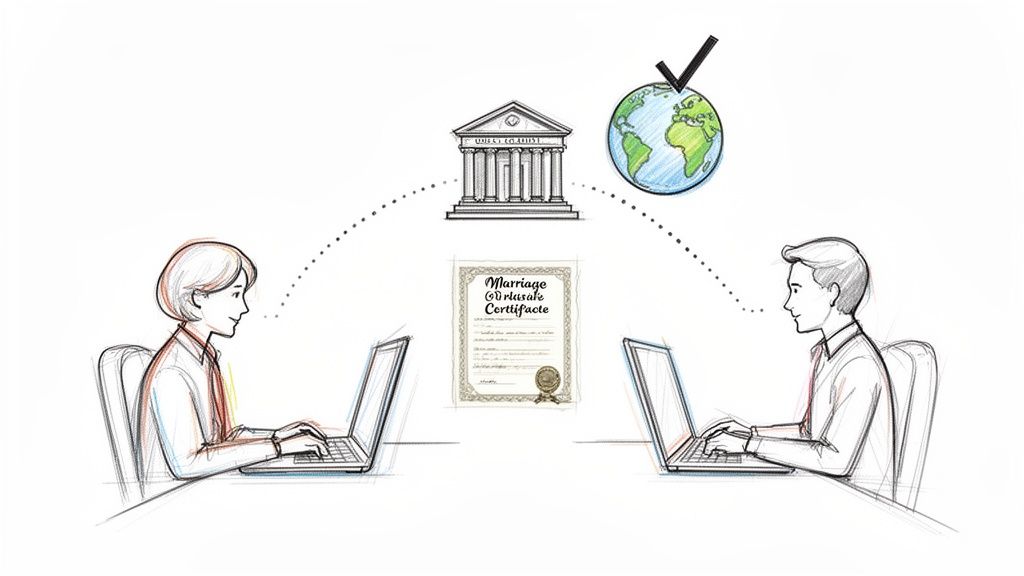
Welcome to the modern way to say “I do.” What was once a niche idea is now a practical, mainstream solution for countless couples. This guide provides an actionable walkthrough of the entire journey, showing you exactly how technology and specific legal frameworks enable legal online marriage.
This process is designed for accessibility. Whether you’re in a long-distance relationship, navigating travel restrictions, or simply want a private, straightforward ceremony, getting married online offers a powerful and efficient alternative to traditional weddings.
Who is Online Marriage For? An Actionable Solution
The flexibility of a virtual wedding is a game-changer. It’s the perfect, practical solution for:
- International and Long-Distance Couples: If you and your partner live in different countries, an online marriage cuts through the logistical hurdles of travel and visa applications just for the ceremony.
- Military Personnel: Deployed service members can legally marry their partners without using precious leave time for travel.
- Couples Seeking Simplicity: Avoid the stress and expense of a large traditional wedding. An online ceremony is intimate, efficient, and focuses on the commitment itself.
- Those with Mobility or Health Issues: When travel is difficult, a virtual wedding ensures that health concerns don’t delay your marriage plans.
This modern approach aligns with how many relationships begin. A recent study for 2025 wedding trends and insights revealed that 27% of U.S. newlyweds met online. Online marriage services are the logical next step, allowing couples to formalize their union without traditional barriers.
The core concept is simple: your physical location should not prevent your legal union. By using a U.S. jurisdiction that permits remote ceremonies, couples anywhere in the world can obtain a valid U.S. marriage certificate.
It’s also important to understand the different types of remote weddings. For a clear breakdown, review our guide on virtual vs. proxy vs. online web conference weddings. Platforms like MarryFromHome.com are designed to manage every step, from legal paperwork to coordinating the ceremony, so you can focus on the event itself.
Key Stages of a Legal Online Marriage
Here is a clear, actionable roadmap of the online marriage process. This table breaks down what happens at each stage, what you need to provide, and the typical timeline.
| Stage | Key Action | What You Need | Typical Timeframe |
|---|---|---|---|
| 1. Application | Submit your online application for a marriage license. | A clear digital copy of a government-issued photo ID for each partner. | 15-30 minutes |
| 2. License Issuance | The county clerk reviews your application and issues a digital marriage license. | Approved application, payment of the license fee. | A few hours to 1 business day |
| 3. Ceremony | Conduct a live video ceremony with a licensed officiant. | You, your partner, a stable internet connection, and the provided video link. | 15-30 minutes |
| 4. Legalization | The officiant digitally signs the license and files it with the issuing county. | Signed digital license from the ceremony. | Immediately after the ceremony |
| 5. Certificate | The county clerk records the marriage and issues the official certificate. | N/A | Digital copy in 1-2 days; hard copy by mail in 1-4 weeks |
Use this table as your checklist to ensure every step is completed correctly, guaranteeing your marriage is legally sound.
How the Law Views Online Marriage
To understand how you can legally marry online, shift your focus from your local city hall to the specific U.S. jurisdictions that authorize this process. The legality doesn’t stem from every state or country allowing online weddings. Instead, it relies on forward-thinking jurisdictions, like Utah County, which have enacted laws allowing anyone to get married there virtually, regardless of their physical location.
This framework is revolutionary. It means a couple—with one partner in Tokyo and the other in Berlin—can obtain a 100% legal U.S. marriage certificate without ever setting foot in the United States. The system is designed to be location-independent, removing the geographical barriers that have historically complicated international relationships.
The Legal Principle That Makes It Work: Lex Loci Celebrationis
The key to global recognition is a legal doctrine called lex loci celebrationis. The concept is simple: a marriage is legally valid if it was valid in the place where it was performed.
Since your online marriage is officially performed and registered in a U.S. county that legally permits it, other states and countries generally recognize it as valid. This is the same principle that makes a destination wedding in Las Vegas legally binding when you return home to London or Sydney. Your marriage’s legitimacy is tied to the jurisdiction where the license was issued, not where you and your partner were located during the ceremony.
For a deeper dive into the legal specifics, visit our page covering the legality of online marriage.
Who Can Get Married Online?
While this process is open to couples worldwide, there are a few basic requirements you must meet to ensure the marriage is consensual and legally sound.
- Age Requirement: Both partners must be at least 18 years old.
- Marital Status: Neither partner can be currently married. You must be single, divorced, or widowed.
- Consent: Both partners must be of sound mind and willingly agree to the marriage.
- Identification: Each partner must provide a valid, unexpired government-issued photo ID.
Here’s a quick guide to acceptable forms of identification.
| ID Type | Is it Accepted? | Actionable Tip |
|---|---|---|
| Passport | Yes | This is the best option for international couples, as it’s universally accepted. |
| Driver’s License | Yes | A current driver’s license from any country is generally sufficient. |
| State/National ID Card | Yes | Any official government-issued identity card will work. |
| Birth Certificate | Sometimes | This may be requested as a secondary document, but you will still need a primary photo ID. |
The process is designed for accessibility. As long as you can prove your identity and meet these basic legal criteria, you are eligible.
Actionable Example: Anna in Germany and Carlos in Brazil have been in a long-distance relationship for years. Getting married in either of their home countries presented a bureaucratic maze of visa rules that could take months. By using an online marriage service based in Utah, they can apply for a U.S. marriage license online, hold a virtual ceremony with a U.S. officiant, and receive a legally binding marriage certificate in days. This U.S. certificate then becomes the foundational document they need for immigration and other legal processes.
This modern framework replaces the physical courthouse with a secure, official video conference, making marriage accessible to anyone, anywhere.
Securing Your Online Marriage License
The marriage license is the official document that authorizes your wedding. Obtaining it is the first concrete step in your legal union. This section provides an actionable guide to getting your license online efficiently.
The entire process is designed to be straightforward. Knowing what to expect at each step will make it feel even smoother.
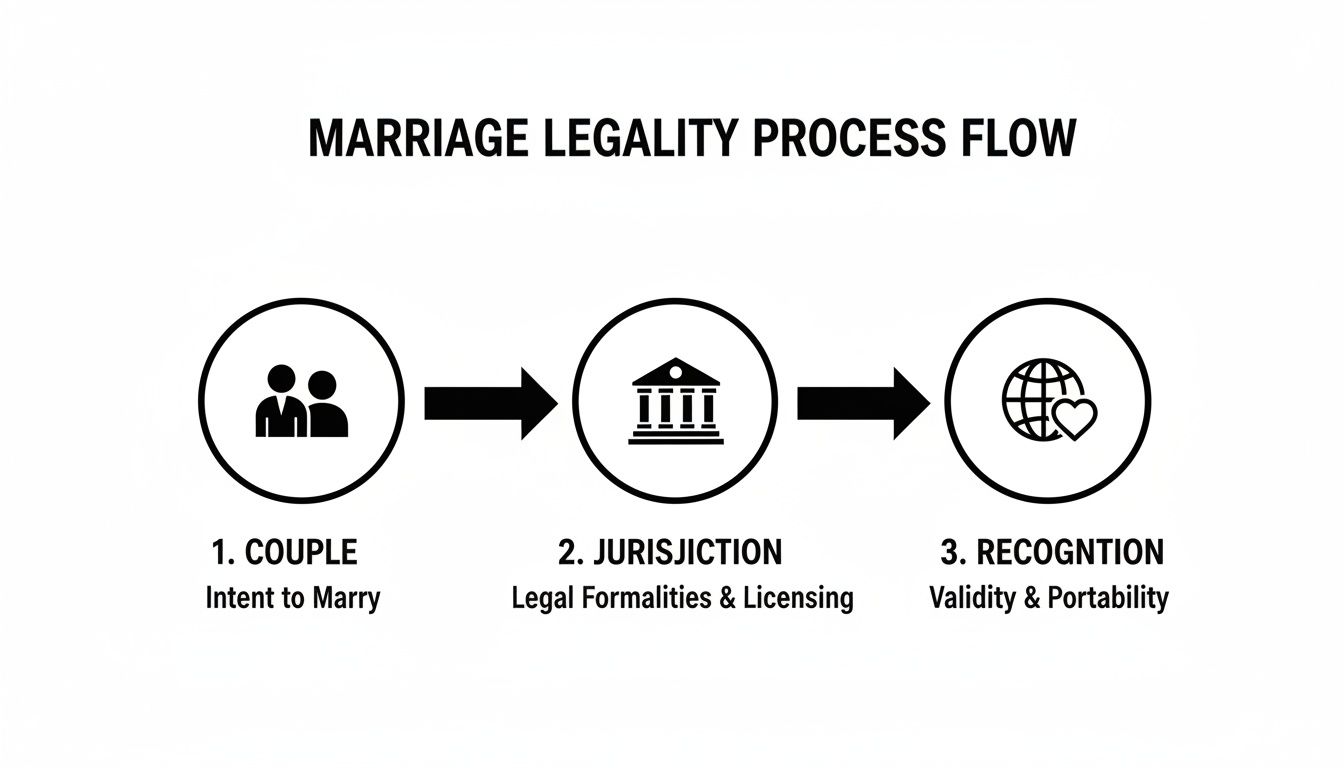
As this shows, your application moves through an official U.S. jurisdiction for legal validation. This U.S.-based approval is what gives your marriage a solid foundation for worldwide recognition.
Step 1: Prepare Your Documents for the Application
Before you begin the application, gather your documents. Having everything ready is the single best way to prevent delays. You will need clear digital copies (scans or high-quality photos from your phone) of your government-issued photo IDs. Minor discrepancies, such as a middle initial appearing on one ID but not another, are rarely an issue as long as the core information—full name, date of birth, and photo—is a clear match.
Here is your document checklist:
- A valid Passport: The preferred ID for international couples.
- A Driver’s License or National ID Card: Any current, government-issued photo ID is also acceptable.
- Proof of Prior Divorce (if applicable): If you have been married before, you will need to provide the date and location of your last marriage’s dissolution. Have a digital copy of the final divorce decree ready in case it is requested.
Step 2: Complete the Online Application Form
With your documents prepared, you can fill out the online application. This form collects the essential details the county clerk needs to issue your license.
Actionable Tip: Accuracy is critical. Double-check every entry before submitting, especially the spelling of your names and your dates of birth. A simple typo can cause significant delays. Take an extra 60 seconds to review all information.
You will be asked for basic details: full legal names, current addresses, dates and places of birth, and your parents’ full names and birthplaces. To see a detailed overview of the application, read our guide on how to get a legal marriage license online.
This streamlined approach to marriage paperwork reflects modern relationships. With over half of recently engaged couples meeting on dating apps, it is logical for the marriage process itself to move online, removing geographical barriers for those who connected virtually.
Step 3: Attend the Virtual Verification Appointment
After submitting your application, the final step is a brief video call with a representative from the county clerk’s office. This is a quick, formal identity verification step to confirm you both consent to the marriage. It is the digital equivalent of appearing before the clerk in person.
Both partners must be on the call, though you can be in different locations. Each of you will need to hold your original photo ID up to the camera for verification.
Follow these tips for a smooth verification call:
- Perform a Tech Check: Test your camera, microphone, and internet connection beforehand.
- Ensure Good Lighting: Sit in a well-lit area where your face is clearly visible, such as facing a window.
- Have Your ID Ready: Have your passport or driver’s license in hand to avoid delays.
- Choose a Quiet Location: Minimize background noise so you can hear the clerk and be heard clearly.
Once the clerk verifies your identities, they will officially issue your digital marriage license. This is the document your officiant will sign during your ceremony to make your marriage legally binding. With the license secured, you are ready for the ceremony.
Planning Your Virtual Wedding Ceremony
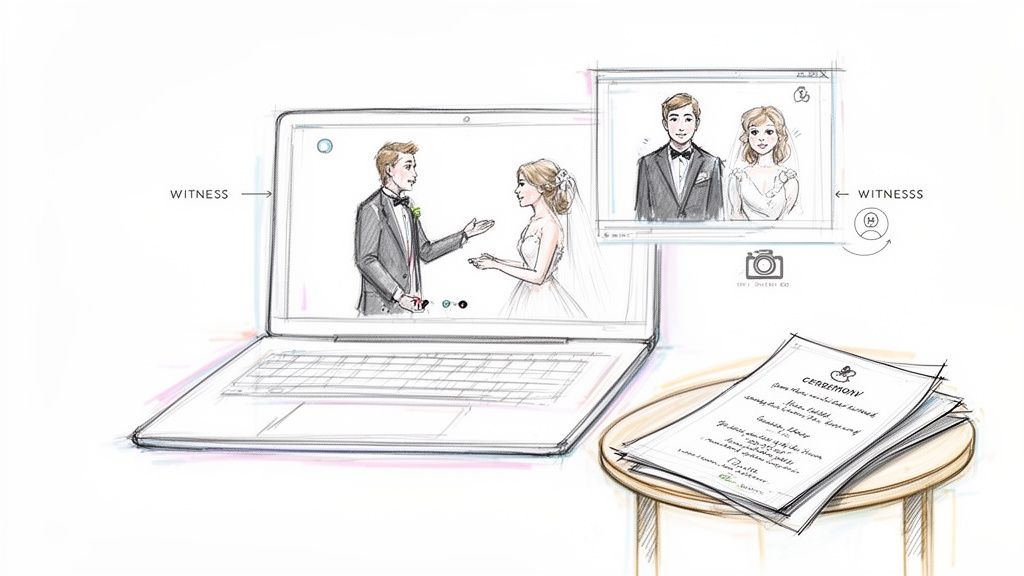
You have the marriage license—now it’s time for the ceremony. This is the moment your union becomes official, and it deserves to feel just as special as any in-person event. A successful online ceremony balances legal requirements with the personal touches that make the day uniquely yours.
This section provides actionable steps for planning a virtual wedding that is both legally sound and unforgettable.
Setting the Stage for Your Virtual Vows
First, handle the logistics. A small amount of technical preparation can ensure a smooth, stress-free ceremony.
Choose a location with good lighting and a clean, uncluttered background. A simple backdrop, a vase of flowers, or a few meaningful photos can instantly transform a space. A stable internet connection is crucial; use a wired Ethernet connection if possible, as it is more reliable than Wi-Fi. It is also wise to conduct a tech rehearsal a day or two before the ceremony. Schedule a test video call with a friend to check your camera, microphone, and software.
The Legal Core of the Ceremony
While you can customize your ceremony, a few key legal actions must occur. These are the elements that officially change your marital status. Your officiant will guide you through them.
The three non-negotiable legal requirements during the ceremony are:
- Visual Confirmation: You and your partner must be clearly visible on screen for the entire ceremony so the officiant can confirm your identities and witness your consent.
- Verbal Declaration of Intent: This is the “I do” moment. You must clearly and audibly state your intention to marry. The officiant must hear a verbal “I do” or “I will” from both of you.
- The Pronouncement: After you both give consent, the officiant will make the official pronouncement, declaring you legally married. This is the exact moment the marriage becomes official.
Crucial Legal Point: The officiant must be physically located within the jurisdiction that issued your marriage license during the ceremony. If your license is from Utah County, your officiant must be physically in Utah while performing the ceremony. This is the cornerstone of your marriage’s legal validity.
Crafting a Personal and Memorable Experience
Now, make the ceremony your own. Just because it’s online doesn’t mean it has to be impersonal.
Decide on the tone. Do you prefer a short, simple ceremony or one that includes personal vows, readings, or music? You can share a link with as many guests as you want, allowing friends and family from around the world to celebrate with you.
Here are a few actionable ideas to personalize your ceremony:
- Write Your Own Vows: Sharing personal promises is a powerful way to customize your day.
- Involve Your Guests: Ask a family member to do a reading or have guests post congratulatory messages in the chat immediately after the pronouncement.
- Plan a Virtual Toast: Instruct guests to have a beverage ready so everyone can join a celebratory toast after the ceremony.
- Choose a Meaningful Outfit: Dressing for the occasion makes the day feel significant, whether you choose formal wedding attire or something that is simply special to you.
Your online wedding is a real wedding. By integrating these legal steps into a personalized ceremony, you create a meaningful start to your life together.
After “I Do”: Your Marriage Certificate and Next Steps
You are officially married. So, what comes next? The steps you take after the ceremony are crucial for formalizing your new legal status. This final phase is about the paperwork—transforming your signed marriage license into an official certificate and understanding how to use it for legal purposes.
From License to Legal Certificate
Immediately after your ceremony, your officiant digitally signs your marriage license and files it electronically with the issuing county clerk’s office. This action officially records your marriage with the government.
The timeline for receiving your documents is very efficient:
- Digital Certificate: You will receive a digital copy of your marriage certificate via email within 1-2 business days. This serves as immediate proof of marriage.
- Physical Certificate: A hard copy with the official county seal will be mailed to you, typically arriving within 1-4 weeks, depending on your location.
This rapid turnaround is a significant advantage of the online marriage process, especially appealing to digitally native couples. Platforms like MarryFromHome.com make legal online ceremonies highly accessible. This trend aligns with insights from The Knot Worldwide’s report on 2025 wedding trends and insights, which notes that 86% of Gen Z see marriage in their future, suggesting a growing demand for modern, digital unions.
Do You Need an Apostille?
For international couples, a standard U.S. marriage certificate is often just the first step. If you plan to use your certificate for legal matters outside the U.S.—such as immigration, visas, or official recognition in your home country—you will almost certainly need an Apostille.
An Apostille is an international certification that authenticates a public document. It confirms to other countries that your U.S. marriage certificate is legitimate and can be accepted as valid.
To obtain one, you send your physical marriage certificate to the Secretary of State in the state where it was issued (e.g., Utah). They verify the county clerk’s signature and attach the Apostille. This step is essential for ensuring your marriage is recognized abroad without complications.
Your Post-Ceremony Document Checklist
With your legal documents in hand, you can begin updating your status. This checklist outlines the documents you will manage.
| Document Type | Purpose | How to Obtain | Who Needs It? |
|---|---|---|---|
| Digital Marriage Certificate | Immediate, informal proof of marriage. | Emailed from the county clerk after the ceremony. | All couples. |
| Physical Marriage Certificate | Official legal proof for domestic use (e.g., name changes, insurance). | Mailed after the digital copy is sent. | All couples, especially those in the U.S. |
| Apostille | International validation for visas, immigration, and foreign legal recognition. | Apply via the issuing state’s Secretary of State. | All international couples needing to use their certificate outside the U.S. |
After receiving your certificate (and Apostille, if needed), you can proceed with important tasks like updating your name on your Social Security card, driver’s license, and passport. You will also need to update your marital status with employers, banks, and insurance companies to solidify your new legal standing.
Common Questions About Legal Online Marriages
It is normal to have questions when exploring a modern approach to marriage. This section provides direct, actionable answers to the most common inquiries, helping you move forward with confidence.
Is an Online Marriage from a US State Legally Recognized in My Country?
Yes, in most cases, it is. Thanks to the legal principle of comity and international agreements like the Hague Convention, a legally performed marriage in one jurisdiction is typically recognized worldwide.
The same logic applies as it would to a destination wedding in Las Vegas—your marriage remains valid when you return home.
For official use outside the U.S., such as immigration, you will almost certainly need an Apostille. This certification verifies your U.S. marriage certificate for foreign governments. While the system is designed for global acceptance, it is always a good practice to check with a local authority in your country for any specific requirements.
The Key Takeaway: Your marriage’s legal validity is tied to the U.S. jurisdiction that issues the license, not your physical location during the ceremony. This is what enables its international recognition.
What Happens If Our Internet Connection Drops During the Ceremony?
Don’t worry—professional online marriage services are prepared for technical glitches. If your connection is briefly interrupted, the officiant will pause and wait for you to reconnect.
If a significant outage prevents the ceremony from continuing, it will be rescheduled for another time, typically at no additional cost. The critical legal moments—your declaration of intent (“I do’s”) and the officiant’s pronouncement—must be clearly seen and heard. Your officiant will manage any interruptions to ensure all legal requirements are met.
Can We Have Guests Attend Our Virtual Wedding?
Absolutely! This is one of the greatest benefits of an online wedding. You can invite friends and family from anywhere in the world to watch your ceremony live.
Most platforms provide a shareable link for guests. They can join the video call to celebrate with you in real time. While you, your partner, and the officiant have specific legal roles, your guests can simply log in and enjoy the celebration. It’s an excellent way to include everyone who matters most, regardless of distance.
Ready to formalize your union without borders or bureaucracy? Marryfromhome.com manages the entire process, from the application to your final legal certificate. Start your journey today!


